The client
The client is a Life Sciences & Biotech giant company sepcializing in health tech, diagnostics, and precision medicine. Their WordPress site had been serving two audiences at once: patients weighing their options and the physicians and pathologists who order the company’s testing. With a slew of product launches ahead, the goal was to help each audience find relevant information, and attract more business through the website.
The legacy site had carried the client through an earlier stage of growth. Its front end ran on a page builder, with custom plugins that each added a post type and shortcode to feed it. As the company’s ambitions grew, most page changes ran through a developer, and leadership wanted to give its in-house team a simpler, faster way to work.
That’s when the client brought in rtCamp, a WordPress VIP Gold agency partner, to work alongside its in-house team and creative agency, with one ask: rebuild on WordPress VIP, and put publishing in the content team’s hands.
At a glance
IssueSolutionOutcomeTechnical debt: a page builder bloated every page, and a sprawl of custom plugins made the codebase challenging to maintain.Rebuilt the front end in native Gutenberg and folded the custom plugins into one features plugin.A faster site for every visitor and a lighter maintenance loadPublishing bottleneck: The content team could not ship a page without a developer.A reusable kit of 27 blocks and 33 patterns across 14 templates, plus training.Product launches ship on the content team’s schedule, with no engineering bottleneck.Regional compliance: Product content had to change by country.Region awareness built into the blocks, resolved server-side on WordPress VIP.Every market gets compliant content from one page, with no duplicates to manageA high-stakes cutover: going live on a busy, active site without breaking it.Rehearsed on preprod, with old media retired at the file-system level.A clean, low-risk launch with no compliance exposure.
From technical audit to improved site performance
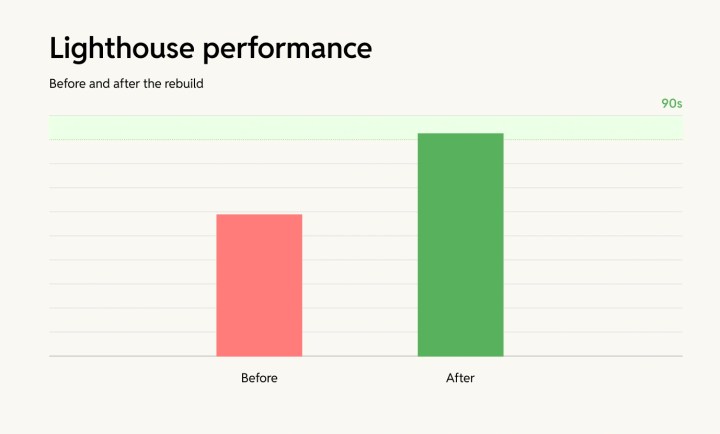
rtCamp and the client opened with a full audit of the homepage’s code and plugins. The page was failing Core Web Vitals — Google’s measure of how fast and stable a page feels, and a factor in search ranking. The causes were typical of a slow page: render-blocking resources, unused CSS and JavaScript, and an oversized DOM. Essentially, too much code loading before a visitor saw anything. Lighthouse, Google’s testing tool, scored it 59.
The root cause was the drag-and-drop page builder, that generates bulky, deeply nested code. rtCamp recommended rebuilding the homepage on native Gutenberg, WordPress’s built-in block editor, whose leaner output shrank the page size and cleared any unused code.
The old build had also disabled concatenation, one of WordPress VIP‘s own optimizations, which bundles many small files into a few so the browser loads them faster. Restoring it cut the files blocking each page load. Two more changes helped: shortcode-based features were rebuilt as native blocks (a gene-search tool now pulls results from a dedicated API), and the client’s scattered custom plugins were reviewed and folded into a single must-use plugin, tidying the codebase.
Faster across the site
The rebuild lifted Lighthouse performance above 90 across nearly every page, and the homepage gained the most where it had scored lowest. The clean, block-based foundation behind those gains is what the content team now builds on.
Enabling editorial freedom with custom WordPress blocks
With new product launches on the horizon, client leadership wanted its content team enabled to build and ship pages without raising tickets for developers. Publishing independence & velocity were the headline goals here.
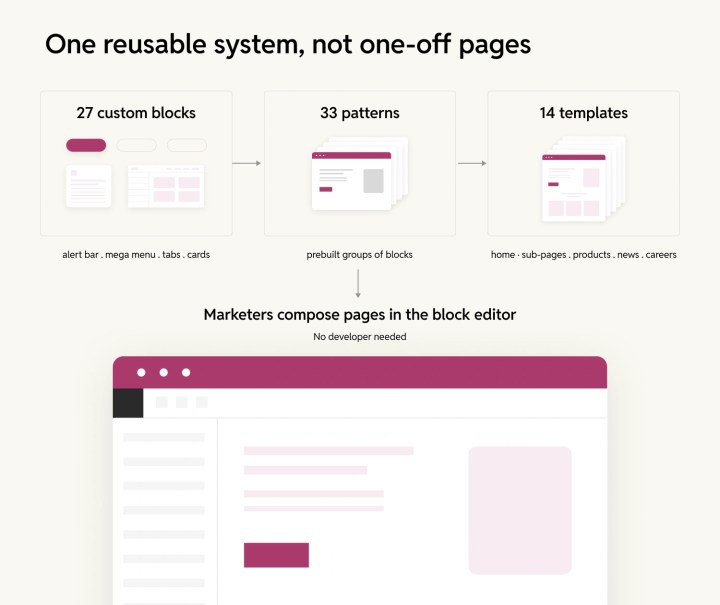
Working with the creative agency’s designs, rtCamp built the site as a full site editing theme on its block-theme starter, hosted on WordPress VIP. Recreating every page-builder layout in Gutenberg produced a reusable kit of 27 blocks and 33 patterns across 14 templates, including:
- a region-aware alert bar and mega menu
- six tab variants
- three card systems
- a flexible subpage template, a full-width canvas with no forced title that gives the content team a blank slate
rtCamp then trained the content team to assemble and ship pages from those parts.
Now the content team builds and ships pages on its own, so a product launch no longer waits on a developer. Accessibility reached 100, up from the low 90s, and per-page WCAG 2.1 AA scores between 96 and 99. With publishing handled in-house, the team turned to another requirement: serving different content to different markets.
Regional content optimization
Regulations differ by country, so the site has to show different content in different markets. Building a separate page per country would have multiplied the work and the room for error.
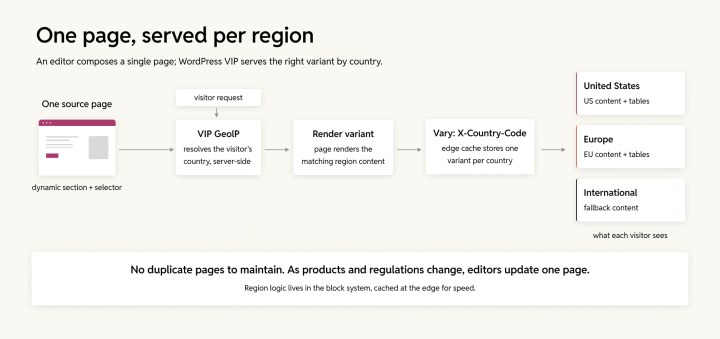
rtCamp built region awareness into blocks, pairing a dynamic section with a selector that controls it. WordPress VIP’s GeoIP signal reads the visitor’s country on the server, and a Vary header keyed to that country code lets the edge cache hold one fast variant per region.
The content team composes a single page, and visitors in New York, the wider United States, and international markets each see the content meant for them. There are no duplicate pages to keep compliant as products and regulations change. With the build done and the publishing model set, one job remained: a clean launch on a site patients and physicians rely on.
Launching without disrupting live operations
The transition to the new site was particularly sensitive due to two factors. First, the team needed to align the new build with the latest WordPress and plugin updates while the legacy site remained active. Secondly, outdated media represents a major risk to compliance for a diagnostic company. If legacy assets are not retired, they can surface in search results in place of current materials.
To ensure a clean launch, rtCamp sequenced media and database imports using scripts and then conducted a comprehensive pre-production rehearsal; by preemptively clearing 1,500+ merge conflicts and scrubbing legacy media, the team successfully executed the site cutover with zero compliance exposure.

The new site went live, deploying 8,397 files in a single, seamless release. This milestone marked the beginning of an ongoing partnership.
Sustaining success through long-term support
In the months since, rtCamp has kept the site current and secure: a PHP 8.2 upgrade, a WordPress core update, a move from CircleCI to GitHub Actions, regular plugin and security updates, and a cleaner tag-manager setup through a WordPress VIP environment variable. Every change ships through the same reviewed develop-to-production pipeline, with the client’s sign-off on each release.
The partnership has successfully put the content team in the driver’s seat. While rtCamp ensures the site remains high-performing and secure through ongoing maintenance.
rtCamp specializes in WordPress modernization projects. You can reach out to them here.
Related case studies
-
University of Findlay: From SharePoint to WordPress, built for growth & ease of use
Solution
WordPress Migration
Industry
Education
-
The Indian Express : From Code Reviews to Editorial Independence
Solution
WordPress Development
Industry
Publication and Media