





Trusted by the world’s leading brands








Sounds familiar?
Maintaining Drupal has become a costly job, and the following is no longer a surprise

A module your site depends on hasn’t been updated in years. No guarantee it will be.

Your editors can update text. Anything else (like a new layout) needs a developer ticket.

Your team just scoped the next Drupal upgrade. Doesn’t look pretty.

Your Drupal developer just quit. No success looking for a replacement.

In 2–3 years, another core update drops. The whole upgrade cycle starts again.
Leaving Drupal is the right call.Don’t let a poor migration ruin it
In every Drupal migration, the same three things go wrong. Here’s how we handle each one.

SEO performance
You’ve spent years building search rankings. Without proper URL mapping and redirect validation, none of that carries over.

How we prevent SEO decline
We audit every URL before migration begins, validate redirect chains, and run a crawl simulation before DNS switch.

Content integrity
Drupal’s node structure, taxonomy system, and Views don’t have direct WordPress equivalents. Without careful planning, content arrives structurally broken.
How we prevent content loss
We inventory every content type, taxonomy vocabulary, field, and view during discovery. Everything is validated against the source.

Team productivity
Your team couldn’t publish independently on Drupal without a developer. A bad migration just recreates that dependency on a new platform.
How we prevent adoption failure
We map your team’s actual publishing operations and build around that. Live training and 30 days of Hypercare are standard.
FleetNet America migrates fromDrupal 9 to WordPress VIP with 2x Core Web Vitals improvement

rtCamp’s remarkable Drupal to WordPress migration, completed in just a few weeks, was a game-changer for FleetNet America. This initiative had a noteworthy business impact, with a 2x increase in performance. WordPress, known for its versatility, proved to be an excellent choice for our Enterprise B2B needs.

Samantha Blum
Digital Marketing Manager


Drupal’s EOL cycle means you’re rebuilding either way.Here’s where you could land
A practical comparison for teams building the internal business case.
 Stay on Drupal Stay on Drupal |  Move to WordPress Move to WordPress | |
|---|---|---|
| Upgrade cycle | A new major version hits EOL roughly every 2–3 years. Each one requires a rebuild of custom code, modules, and integrations. | Backward compatible. No forced replatforms. You upgrade when you choose to. |
| Annual cost | Developer costs for maintenance, module fixes, and upgrade cycles add up. Enterprise 4-year TCO estimated at $470K–$1M. | You invest in what you build, not in maintaining what you have. |
| Editorial independence | Developer-oriented by design. New layouts, content types, and page structures call for developer involvement. | Gutenberg gives editors a visual block builder. Marketing publishes independently without developer tickets. |
| Module ecosystem | Many contrib modules are unmaintained. Module conflicts require custom fixes at every major upgrade. | 60,000+ plugins. Active ecosystem. Plugin compatibility is rarely a blocker. |
| Ownership | Open source. When Drupal releases a new version or ends support, you have to rebuild. | Open source. You own everything and control your own roadmap. |
Done rebuilding your codebase every few years? On WordPress, you won’t have to.
What you gain on WordPress
Own the infrastructure, control the roadmap, and publish without waiting on developers.

Owned infrastructure
No licensing fees. Your codebase is yours. You can fork it, extend it, or change partners without replatforming.

Editorial independence
Gutenberg blocks give marketing teams an on-brand page builder. You can edit, publish, and update pages without developer tickets.

Composable architecture
Connect the best-of-breed tools you choose — analytics, CRM, ad tech. No bundled vendor, no module dependency chain.

The largest talent pool in CMS
50,000+ WordPress developers globally. WordPress VIP adds enterprise hosting, security, and support.
How we migrate from Drupal to WordPress
Our approach draws from 50+ enterprise migration projects. Five phases, no big-bang launches. All engagements start with 20 hours of free discovery.
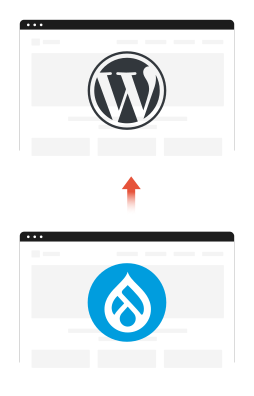
Migrate fromDrupal to WordPress


Everything that matters,
protected
Every migration puts six things at risk. We engineer against all of them.
SEO equity preserved

Maintain your ranking authority across every URL
We audit every URL before migration begins, validate redirect chains, and run a crawl simulation before the DNS switch.
Content integrity validated

Transfer every piece of content without loss
We validate every node, taxonomy relationship, and media asset individually against the source. No bulk exports.
Editorial workflows rebuilt

Publish on day one without relearning everything
Gutenberg blocks and editorial tools designed around how your team actually works, not generic templates adapted after launch.
Integrations maintained

Keep your existing tools connected and working
CRM, analytics, marketing automation, and forms rebuilt and tested against production traffic before go-live.
Zero downtime deployment

Launch without taking your site offline
New platform built in parallel. Blue-green deployment with instant rollback. Your Drupal environment stays live until you’re ready.
Team enablement included

Operate the platform independently from day one
Our standard deliverables include technical and editorial documentation, live training sessions, and 30 days of dedicated Hypercare support.
Why choose rtCamp for
Drupal migration
We have proven enterprise WordPress development expertise.

Known for complex WordPress migrations
50+ enterprise projects. We’ve migrated FleetNet America with 2x Core Web Vitals, Cox Automotive Mobility (Drupal → WordPress VIP multisite), and dozens of enterprise Drupal sites.

We’ll tell you if you don’t need us
If upgrading Drupal core genuinely makes more sense for your situation, we’ll say so. We don’t oversell migration.

WordPress VIP Gold agency
Core contributors for 34 consecutive WordPress releases. 200+ engineers in-house. SOC 2 compliant. 96% client repeat rate.
Why enterprises trust rtCamp
What ourclients say
We started off young, back in 2011, with an idea that evolved into a big company.


rtCamp’s remarkable Drupal to WordPress migration, completed in just a few weeks, was a game-changer for FleetNet America. Their expertise transformed our online presence, elevating user experience and functionality, with a 2x increase in performance.


We needed a faster site that gives our marketing team control and flexibility. We got just that. The rtCamp team was responsive and collaborative throughout, listening to us, identifying our problems, and making a shift to solutions that just worked for us/supported the way our team works.
Planning to move from Drupal to WordPress?
Book a free consultation and we’ll recommend the right approach.
Check outour resources

Handbook
Drupal vs WordPress comparison guide

Handbook
Drupal to WordPress migration guide

case study
FleetNet America case study
Frequently asked questions
It depends on why you’re on Drupal. If you have strict compliance requirements (multi-stage approval workflows, audit trails, regional publishing gates) Drupal handles these natively, and WordPress needs custom architecture to match them. That’s a solid reason to stay.
But most organizations are on Drupal because of inertia, and leaving felt riskier than staying. If that sounds familiar, this EOL cycle is the right moment to make the switch. Both paths require effort. But only one of them ends the cycle. Not sure which camp you’re in? That’s what our free discovery is for.
Taxonomy vocabularies become WordPress custom taxonomies. Content types become custom post types. Custom fields migrate using WordPress’s native custom field system or dedicated plugins. The relationships between content (the part that trips up most migrations) get inventoried during discovery and rebuilt individually. Nothing is assumed to transfer automatically.
Views don’t have a direct equivalent in WordPress, so each one gets rebuilt. During discovery we go through every View on your site and determine the best approach: custom WP_Query logic, Gutenberg block templates, or purpose-built plugins for complex filtered displays. You’ll know what’s involved before development begins.
Yes. Our client Cox Automotive had thousands of pages across a multisite network. We migrated in weeks with 2x Core Web Vitals improvement. Videojet had 12,000+ pages across 28 sites in 22 languages. Content volume alone doesn’t determine complexity. Its structure does. That’s what we scope in discovery.
Most enterprise Drupal migrations range from $50K–$200K and take 2–4 months. The main drivers are content volume, number of custom content types and Views, and integration complexity. We start every project with up to 20 hours of free discovery to scope the work before any contract is signed.
WordPress isn’t insecure, with problems coming from poor implementation. WordPress VIP provides SOC 2 compliance, FedRAMP Moderate authorization, and 24/7 security monitoring. rtCamp is SOC 2 compliant and enforces controlled plugin governance on every project. NASA and the White House run on WordPress. Both switched from Drupal, by the way.
WordPress handles basic role-based permissions natively: who can publish, edit, or view content. For multi-step editorial workflows (draft, review, approval, publish), plugins like PublishPress replicate what Drupal’s Content Moderation module does. For more complex governance requirements, like field-level permissions or regional publishing controls, we build custom solutions during the architecture phase. We scope this specifically during discovery so there are no gaps post-launch.
Yes, and most find it significantly easier than Drupal day-to-day. Routine updates don’t require developer involvement. Every engagement of ours includes documentation, live training, and 30 days of Hypercare
For most organizations, yes. Custom post types, complex taxonomies, multi-step workflows, multilingual content, headless delivery — WordPress handles all of these with the right architecture. If your site has deeply nested entity relationships or highly granular field-level permissions at scale, those need more deliberate architecture. Our free 20h discovery tells you exactly what’s straightforward and what needs custom work before you commit.