




Contentful to WordPress migration services
Contentful’s pricing looked reasonable until your team needed to grow. API limits, content type caps, and renewal quotes that only go up. We’ll get your enterprise off Contentful. Every entry, URL, and integration, without downtime, data loss, or a months-long SEO recovery.
Trusted by the world’s leading brands
Fortune 500 marketing teams. Award-winning newsrooms and publishers. Global automotive networks.
They chose WordPress. Then they pick rtCamp to build it right.







WordPress VIP Gold Agency Partner since 2016


Top Partner Innovator Award
WPVIP 2022
You didn’t make the wrong call
You chose Contentful because it made sense at the time. The API was clean, the content model was structured, and the headless pitch matched your architecture.

Limits that scale against you
Contentful’s mid-tier caps content types at 50. For enterprises with growing content needs, that ceiling is an expensive wall.

Pricing that moves after you’re locked in
The pricing model meters API calls, spaces, locales, and users simultaneously. Costs escalate quickly and often without warning.

An editor experience built for developers
Contentful’s interface is built around technical know-how. Even after initial setup, editors still rely on developers for day-to-day tasks.

A data format designed to trap you
Your content lives in a format only Contentful can read natively. Getting it out means writing scripts that no off-the-shelf tool handles.
The numbers behind the work
What took time to show up
The pricing restructure you didn’t see coming
In January 2023, Contentful restructured its pricing. Some teams on the $300/month Basic plan were quoted almost seven times more to stay. Their enterprise contracts now average $33,000 to $70,000 per year, with 3 to 7% annual escalations written in. The product stayed the same, while the bill didn’t.

The developer dependency your editors inherited
Contentful was built for developers, and it shows. Editors work in form fields with no visual context for how content renders. No WYSIWYG, no live preview. Publishing a single blog post takes an average of 1.5 hours for a non-technical editor. In WordPress, the same task takes minutes.

The content type ceiling you’ll hit when it hurts most
Contentful’s mid-tier caps content types at 50. When a mature content architecture needs more, the only path forward is a custom enterprise contract. Contentful’s April 2025 pricing update cut free-plan API calls to 100,000/month, and teams have documented entire engineering sprints dedicated to reducing call counts just to stay within limits.

The exit cost you discovered too late
Contentful’s Rich Text stores content as aproprietary format that no other CMS can open directly. There’s no export button. Every time your team considers leaving, the cost of that format tips the decision toward staying. That’s their business model. We’ve done this migration work enough times that the exit cost is smaller than Contentful’s architecture implies.


Leaving Contentful feels risky. Here’s why it isn’t.
According to Gartner, 83% of data migrations fail or exceed budget. A Search Engine Journal study found that 17% of migrated sites never recover their organic traffic. Both describe the same mistake: treating migration as an import job. We don’t.

Every entry validated before we go live
We export your full Contentful space via CLI and store your raw Contentful JSON as WordPress post meta throughout migration. Every entry gets a unique ID mapping table. Before production is touched, automated comparison scripts validate entry counts, field values, asset URLs, and taxonomy assignments against the Contentful source. You get a pass/fail report per field, not a verbal assurance.

A custom renderer for your content model
Every node type in Contentful’s AST (paragraphs, headings, embedded entries, inline assets, code blocks, tables) requires a custom renderer producing valid Gutenberg block markup. We build that renderer for your specific content model and test edge cases before import runs. Tables inside callouts, code blocks inside list items, and entry embeds inside rich text. We’ve seen what breaks. We write for it before it does.

The redirect map starts before migration does
The redirect map starts before a single line of migration code is written. Every URL gets crawled and mapped. Title tags, meta descriptions, Open Graph tags, and structured data move into Yoast or Rank Math during migration. We benchmark three months of organic data before cutover and monitor Google Search Console for 90 days.

Both systems run in parallel until you’re ready
Contentful and WordPress run in parallel throughout migration. Every integration gets documented in discovery, rebuilt in staging, and validated before any consumer switches over. DNS cutover uses blue-green deployment, keeping rollback available throughout. In 300+ migrations, we have a 100% completion rate.
The WordPress architecture you wanted when you chose Contentful
Most teams didn’t choose Contentful because they wanted it. They wanted structured content, API-first delivery, or a decoupled frontend. WordPress delivers all three.

Traditional WordPress
For teams whose editors have been filing developer tickets for two years and are done with it, WordPress’s block editor gives editors visual, in-context control without touching code. Custom Post Types and Advanced Custom Fields handle structured content with the same discipline as Contentful’s model. Content publishing stops requiring developers, so the support queue shrinks on its own.

Hybrid WordPress
For teams delivering to multiple channels, whether web, mobile app, partner feeds, or digital signage. WordPress handles the primary web experience through traditional rendering while exposing structured content via REST API or WPGraphQL for any downstream consumer. One source of truth, no sync jobs, no content sprawl across Spaces.

Headless / Decoupled WordPress
For teams that chose Contentful for API-first delivery and want to keep the frontend they’ve built. Your Next.js, Astro, or Nuxt frontend pulls content via WPGraphQL, the same GraphQL query patterns pointing at a different endpoint. Al Jazeera runs GraphQL with React. TechCrunch uses React and Redux. BBC America uses Next.js. All on WordPress.
Why enterprises choose rtCamp
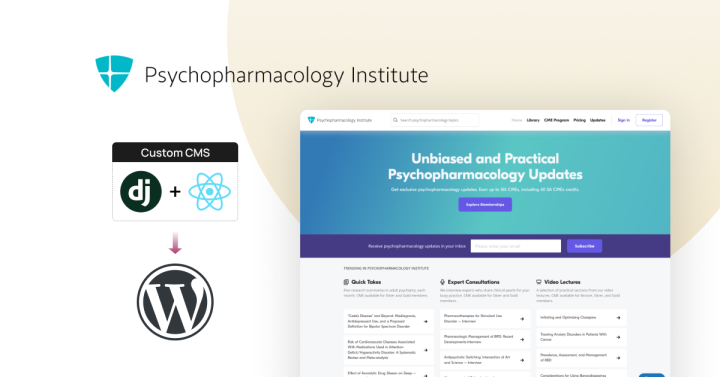
Psychopharmacology Institute’s Strategic Transition to WordPress
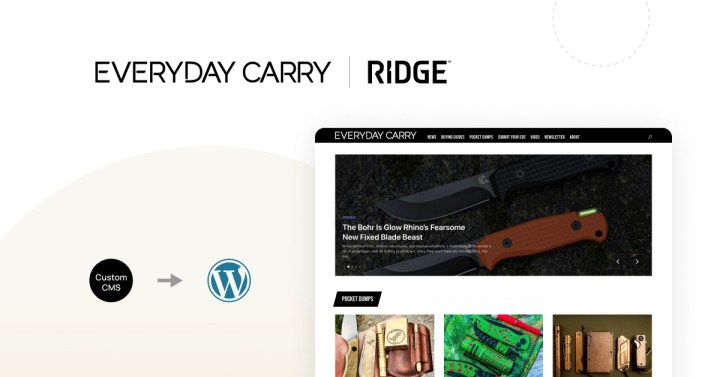
Custom CMS to WordPress Migration for Everyday Carry
How our Contentful toWordPress migration works
The scope varies by project. The process doesn’t.


What you gain when you migrate from Contentful to WordPress

Publishing gets faster
Gutenberg’s block editor is visual and in-context. Publishing a blog takes around an hour in Contentful, but it only takes minutes in WordPress. And developers stop being a dependency in the content workflow.

Your content architecture stops being a ceiling
WordPress has no content type limits, no API call caps, no locale pricing, no environment pricing. When your content model needs a new type, you add it. When traffic spikes, infrastructure scales. No overages, no renegotiations mid-contract.

The licensing math changes
A Forrester TEI study commissioned by Automattic found 415% ROI over three years for organizations on WordPress VIP. For most enterprise teams, the migration investment is recovered from licensing savings alone within 12 to 18 months.

Your frontend stays exactly as it is
If your team built on Next.js, Astro, or Nuxt, it keeps working after migration. Your frontend consumes WPGraphQL instead of Contentful’s API, with no per-call pricing and no rate limits. Nothing else changes.

Compliance gets easier, not harder
WordPress VIP holds SOC 2 Type II and FedRAMP authorization with built-in auto-scaling for traffic spikes of any size. Unlike Contentful’s cloud-only model, you choose your hosting. EU residency, private cloud, and air-gapped environments are all options.

We’ve been very impressed with the flexibility and expertise of rtCamp’s team, who implement a wide range of website features and functionalities for us. Their work continues to add so much value to our articles and award-winning special features. We’ve also been thankful to rtCamp for consistently being available and on point for last minute projects and tasks. The team also chimes in when it’s time to optimize and improve different core components of our site, on top of juggling multiple moving parts day to day. Lastly, collaborating and communicating with the rtCamp team has been a real pleasure. I look forward to what else we can accomplish together.

Jason Castro
Product Manager
Contentful and WordPressComparison Matrix
| Contentful | WordPress | |
| Annual cost (enterprise) | $33K–$70K+/year, escalating 3–7% | Open-source core + hosting |
| Content type limits | 25 (free) to 50 (mid-tier) | Unlimited |
| Data ownership | Proprietary AST format | Your data, your format, your servers |
| Exit cost | High (proprietary format) | None |
| API rate limits | 7 req/sec (CMA) | None |
| Editor experience | Form fields, no visual preview | Full WYSIWYG block editor |
| Architecture options | API-first only | Classic, Hybrid, or Headless |
| Open source | No | Yes |
| Plugin ecosystem | Marketplace integrations | 61,000+ plugins |
| Talent availability | Contentful-certified pool | Millions of developers, 60+ WPVIP-certified enterprise agencies |
| Compliance | SOC 2 via Contentful’s cloud | SOC 2 + FedRAMP via WordPress VIP |
| Hosting flexibility | Contentful’s cloud only | Any provider, including WordPress VIP and Pagely |
No pitch deck. No contract. Just a conversation.
Tell us what you’re running on Contentful, and we’ll tell you exactly what your migration involves.
We offer 20 hours of free technical consulting before any engagement starts. That time is yours, whether you work with us or not.


rtCamp’s thoughtful and low-disruption approach to the migration made the process smooth and seamless. This partnership has laid the groundwork for a powerful platform that can support advanced features and expansion—the proof being our recent acquisition of Pinstripe Media, adding 4 additional media properties to our portfolio. rtCamp remains a reliable partner as our platform continues to grow and evolve.

Kevin Cooper
Chief Growth Officer
Contentful to WordPress migration FAQs
Get answers to some of the most frequently asked questions about migrating websites from Contentful to WordPress!
Yes. WPGraphQL generates a fully schema-typed GraphQL endpoint from your registered post types and custom fields. The queries your frontend team writes today against Contentful’s API translate to WPGraphQL queries with minor syntax differences. Your Next.js or React frontend keeps working, pointing at a different endpoint.
Nothing has to change. If you’re running Next.js, Astro, Nuxt, or any other frontend against Contentful’s API today, it runs against WordPress’s API after migration. Al Jazeera, TechCrunch, and BBC America all run their frontends against WordPress — the same architecture your team would move to.
Contentful’s Rich Text stores content as a proprietary JSON Abstract Syntax Tree, not HTML, not Markdown. We build a custom renderer that maps every node type to valid Gutenberg block markup. Every edge case your content contains (nested lists, embedded entries, code blocks, inline assets) gets a tested renderer before import runs. This is where many migrations break. We’ve mapped the failure modes.
WordPress multisite or our OnePress multi-brand platform handles this. Multiple Spaces become multiple WordPress sites on shared infrastructure, with unified user management, shared block libraries, and consolidated hosting. We’ve built this for Cox Automotive (7 brands), Private Media (3 publications), and Penske Media Corporation (dozens of properties).
No. Both environments run in parallel throughout migration. API consumers switch over one at a time, validated in staging before each switch, and monitored after. The production Contentful environment stays live until every consumer is confirmed working on WordPress.
Every webhook and integration gets documented in discovery and rebuilt on WordPress before Contentful is decommissioned. We’ve integrated WordPress with Algolia, Parse.ly, Chartbeat, Salesforce, Marketo, Cloudinary, and Fastly across previous migrations. Custom integrations are scoped and built as part of the engagement.
Contentful localizes at the field level. WordPress localizes at the post level through WPML or Polylang. That architectural difference needs explicit planning, not a workaround found at import time. We document your localization setup in discovery and design the WordPress equivalent before migration scripts are written. Teams that skip this step spend weeks untangling it afterward.
Sites with fewer than 1,000 entries typically run 4 to 8 weeks. Mid-complexity sites with 1,000 to 10,000 entries take 8 to 16 weeks. Enterprise environments with 10,000 to 100,000+ entries, multiple locales, complex reference chains, and deep API integrations take 4 to 6+ months. We scope every engagement after seeing your Contentful export.
We don’t publish fixed pricing because honest pricing requires seeing the scope. For most enterprise teams, the migration investment is recovered within 12 to 18 months from Contentful licensing savings alone. A Forrester TEI study found 415% ROI over three years for organizations on WordPress VIP.
Extracting structured content from a JSON API is solved engineering. What takes expertise is building the destination. Getting the content model right, the editorial tooling working, the headless layer performing under real traffic. We’ve done that, coming from AEM, Sitecore, Drupal, Kentico, and custom React platforms with the same structural patterns as a Contentful setup. Three hundred migrations. Same rigorous process each time.
Every migration includes a 30-day hypercare period covering daily monitoring, Search Console reporting, Core Web Vitals tracking, and a dedicated Slack channel. After hypercare, ongoing retainers cover development, training, performance optimization, and WordPress core update management.
Blue-green deployment means your WordPress environment is a confirmed production mirror before any DNS change. If anything unexpected appears after cutover, rollback takes the same time as the original switch. We’ve maintained a 100% completion rate across 300+ migrations, the result of planning that accounts for failure modes before they happen.