




Optimizely vs WordPress: A guide for enterprise organizations
Enterprise organizations rarely choose a Digital Experience Platform (DXP) on purpose. A predatory renewal quote or a critical integration failure is usually what forces them to reconsider.
The Optimizely versus WordPress comparison comes down to control. Optimizely bundles its tools into a tightly managed ecosystem, and WordPress gives teams the freedom to build with open source on their own terms.
Drawing on rtCamp’s experience as a WordPress VIP Premier agency, having moved over 300 enterprises to WordPress, including Cox Automotive, Al Jazeera, and PMC, this article provides a balanced look at which architecture serves the modern content stack.
Optimizely: The integrated suite
Optimizely started in 2010 as an A/B testing tool, helping teams run controlled tests on websites to see which version of a page, headline, or button performed better. Episerver acquired it in 2020 and combined that experimentation capability with a full CMS.
The platform now sells itself as Optimizely One, a single package that bundles content management, digital asset management, experimentation, personalization, and commerce into one contract. Teams can test changes without writing custom code. The platform collects the performance data automatically.
The intelligence layer
Opal is Optimizely’s AI layer, and it runs across the entire suite. Since its public launch in May 2025, nearly 900 companies have adopted Opal to automate workflows that range from experiment plans to regional content adaptation.
The value prop
Optimizely sells a single governed ecosystem where everything lives under one contract, aimed at enterprises that want to stop moving data between vendors.
WordPress: The open ecosystem
At the enterprise tier, organizations can choose from competing managed platforms like WordPress VIP, Pagely, and Kinsta and partner with specialized agencies to build custom-fit solutions.
The ownership model of WordPress
No single vendor controls your roadmap or owns your data. You can move your entire stack to another host without rebuilding it.
The value prop
WordPress gives you the option to plug in any tool without being locked into one company’s pricing or product decisions.
The central trade-off
Some organizations benefit from tight integration across one vendor’s products. Others need the freedom to assemble their own tools and swap components when requirements change. The answer differs by organization, and this comparison does not cut corners on Optimizely’s genuine strengths.
At a glance
We’ve compared the two platforms across eight dimensions:
| Issue | Optimizely | WordPress |
| Total cost of ownership | Not publicly disclosed, web experimentation alone ranges $36K–$113K+/year | Open-source core is free, WordPress VIP from $25K/year, 2–3x lower TCO at comparable scale per Forrester TEI |
| Architecture | PaaS (CMS 12/13, .NET) or SaaS CMS (headless-first), hybrid headless supported | Monolith, hybrid, or headless from one open core, any framework, publisher sets rate limits |
| AI readiness | Opal, credit-based billing since May 2025, full integration requires SaaS CMS + CMP, limited on PaaS | No gating, BYOK with any LLM, WordPress 6.9 Abilities API + MCP adapters shipping |
| Experimentation | Native A/B and multivariate testing, Optimizely’s strongest differentiator, Opal users run 78.7% more experiments | Jetpack AI, ClassifAI, and any third-party experimentation tool via open APIs |
| Security/compliance | ISO 27001, SOC 2 Type II, PCI DSS, HIPAA, no FedRAMP authorization | WordPress VIP has FedRAMP Moderate ATO (April 2025) + SOC 2 Type II + ISO 27001, Pagely has SOC 2 Type II |
| Multisite | Multi-site content sharing via role-based permissions, limited per-brand customization without developer work | 1,000+ sites per install, full brand autonomy, OnePress for complex publisher networks |
| Vendor lock-in | .NET stack, proprietary content schema, single certified partner pathway | Open source, publisher-owned data, 60,000+ plugins, competing providers and agencies at every layer |
| DAM | Embedded DAM in SaaS CMS with AI tagging, renditions, saved views | Native media library + GoDAM + choice of enterprise DAM (Cloudinary, Bynder, Aprimo) |
Total cost of ownership

Procurement focuses on the license fee. What matters is the three-year total once you customize, integrate, and scale, and who controls that number.
Optimizely’s pricing is modular and unpublished
Optimizely does not publish pricing. You need a sales call before you see a number, and that number grows with each module added.
The platform bills separately for CMS, DAM, Web Experimentation, Feature Experimentation, Personalization, Content Marketing Platform, and Opal AI.
Web experimentation alone starts around $36,000 per year, reaching $63,700 at 10 million monthly impressions on the Business plan and $113,100 on Enterprise (Convert and Splitbase estimates). Organizations with high traffic report annual spending above $200,000 before implementation.
Every project requires a certified partner at partner rates. Only five Premier Platinum Partners exist globally.
Opal AI moved to credit-based billing in May 2025, per Optimizely’s own release notes. After 30,000 free credits expired in September 2025, every interaction costs credits as a separate line item.
One G2 reviewer paid $66,000 for a plan missing features they requested. Another missed the written cancellation window and owed $24,000 for a product they had stopped using. G2 reviewers also flag charges for unused features and forced tier upgrades.
What this platform choice costs
Estimates for a mid-size media publisher with 10 sites, 50 editors, moderate experimentation usage, and standard compliance requirements. These are not quotes.
| Cost component | Optimizely (PaaS, full suite) | WordPress VIP |
| Platform license / hosting | $150,000–$200,000/year | $25,000/year |
| Implementation (one-time) | $80,000–$150,000 (.NET certified partner) | Included in agency engagement |
| Ongoing development | $60,000–$120,000/year (.NET) | $60,000–$100,000/year (PHP/JS, open market) |
| Editorial plugins | Bundled in license | $500–$15,000/year (dependent on needs) |
| AI costs | Variable credit billing (post-Sep 2025) | None, pay model provider directly at market rate |
| Estimated 3-year total | $700,000–$1,000,000+ | $300,000–$500,000 |
A Forrester TEI study, commissioned by Automattic, found enterprises on WordPress VIP reported 415% ROI over three years, 40% efficiency gains, and 45% lower development costs versus previous platforms. At a comparable scale, WordPress runs 2–3x cheaper when total platform costs are factored in.
WordPress costs less, with vendors competing for your business
WordPress’s open-source core is free. WordPress VIP starts at $25,000 per year, serves The White House, NASA, ADWEEK, and Billboard, and holds FedRAMP Moderate Authorization as of April 2025. Pagely serves Fortune 1000 brands across higher education, media, and enterprise. Pantheon and Kinsta offer enterprise tiers with published pricing.
Your codebase, content, and data move with you to any host. Development talent draws from a global pool of millions. At rtCamp, we provide staff augmentation to place engineers within days. If a vendor changes pricing or drops a product, your platform keeps running.
Support models
Optimizely account teams provide training with paid add-ons for architecture reviews, SEO audits, and workflow mapping. The developer community forum carries a disclaimer that it is “not actively managed or monitored by Optimizely employees.”
WordPress VIP offers 24/7 engineering support and free learning through VIP Learn. Fifty-plus certified VIP agency partners create competition on service quality and pricing.
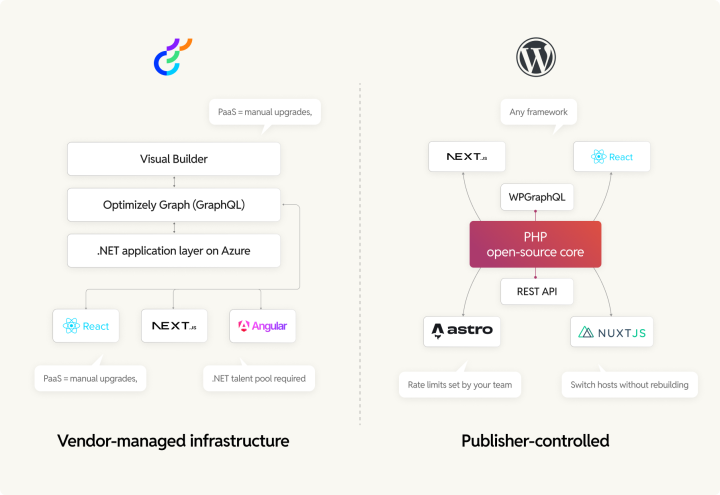
CMS architecture: .NET stack vs open core
Optimizely architecture’s strengths
The SaaS CMS decouples the content backend from the presentation layer, supports hybrid headless delivery, and exposes content via Optimizely Graph to any frontend framework. Visual Builder lets marketers build and preview pages without involving developers.
Organizations already on .NET will find PaaS fits naturally. Gartner Peer Insights reviewers rate the editorial interface as user-friendly, and the CMS-personalization-experimentation integration is a positive for teams that need all three from one vendor.
Where the architecture creates friction
The PaaS path requires .NET developers, a talent pool smaller and pricier than PHP and JavaScript. G2 lists 15 separate mentions of a steep learning curve, and Gartner Peer Insights reviewers flag complex content modeling and a sluggish editor UI with large datasets.
CMS 11 to 12 upgrades typically produce 50+ compilation errors. Experienced consultants recommend starting from a blank solution on large projects, and a routine NuGet upgrade from 12.13 to 12.15 introduced a production caching bug that required a full rollback.
Opal AI works fully only on SaaS CMS paired with the Content Marketing Platform. The direct integration outside CMP or non-SaaS environments is still evolving, and the majority of customers are on PaaS, where Opal remains limited regardless of credit spend.
WordPress runs any framework, built by any team
WordPress supports traditional, hybrid, and headless delivery from the same open core, and the engineering team chooses the architecture without vendor negotiation. Gutenberg gives content creators visual layout control without code, and WPGraphQL exposes the full data model as a typed, configurable GraphQL schema.
WordPress VIP runs across 28 global data centers with auto-scaling and a built-in CDN. The platform served 22 billion requests with 100% uptime during the 2024 U.S. election, and The Indian Express runs 80M+ monthly users on it today.
Digital Asset Management: Bundled vs composable
Optimizely’s embedded DAM works inside its walls
The SaaS CMS ships with an embedded DAM that covers uploads, AI-assisted tagging, renditions, and saved views. The integration works well if your asset needs stay within Optimizely’s defaults.
Portability is a problem. Assets live inside the platform, unpublished assets cannot be accessed externally, and swapping to a different DAM requires a vendor engagement. The 2024 and 2025 CMS release notes log more than a dozen bug fixes for CMP-DAM sync failures alone.
WordPress treats DAM as a composable layer
A bundled DAM cannot match a purpose-built one with a native WordPress integration, especially when your needs span creative teams, brand governance, and multi-region distribution.
GoDAM, built by rtCamp, extends the WordPress media library with folder organization, metadata tagging, video transcoding, and interactive overlays.
Editorial workflow: Turnkey vs configurable


Where Optimizely leads
Built-in A/B testing and personalization is Optimizely’s strongest differentiator. These capabilities are native to the CMS and coupled to the data layer, and Optimizely held leadership positions in three 2025 Gartner Magic Quadrants covering Content Marketing Platforms, Digital Experience Platforms, and Personalization Engines.
The 2025 Opal Benchmark Report found that Opal users ran 78.7% more experiments, launched 24.1% more personalization campaigns, cut campaign completion time by 53.7%, and improved content engagement by 7.4%. Replicating that stack is possible on WordPress through custom development.
Where Optimizely creates friction
The modular billing model charges separately for each capability. Teams that do not run experimentation as a primary function pay for capabilities they never use.
Optimizely’s own documentation states the CMP-CMS publishing integration “does not currently work with CMS (SaaS) sites.” PaaS users connecting CMP need manual NuGet package installation, separate OAuth configuration, webhook registration, and AppSettings JSON edits. Gartner Peer Insights reviewers describe the result as “very basic and limited.”
The editorial calendar is a separate paid product. Opal’s full AI features require both SaaS CMS and CMP running together, so on PaaS, Opal is capped regardless of credits purchased.
WordPress: Editorial workflow built to your newsroom
Gutenberg provides a unified interface for content and layout. Block-based editing gives editors control over columns, media, embeds, and custom blocks without developer time. Full Site Editing extends that control to templates, patterns, and global site design, built into WordPress core with no paid add-on.
rtCamp built custom editorial workflow infrastructure for Grist. The Indian Express manages editorial operations for 80M+ monthly users on WordPress VIP.
AI readiness: Open architecture vs a credit meter

Opal is a serious AI capability. The agentic workflow system lets marketers sequence AI agents for drafting, experiment ideation, translation, SEO auditing, and campaign orchestration. Optimizely’s benchmark data shows 89.5% of AI-generated text and 52.6% of AI-generated images accepted by users.
Opal routes all AI interactions through Google’s Gemini on a credit-based billing model. WordPress connects to any LLM directly, with no intermediary and no usage credits.
On WordPress, Jetpack AI handles drafting, summarization, and image generation inside the editor. ClassifAI integrates content classification and tagging. Yoast and RankMath apply AI to SEO metadata.
BYOK means you connect OpenAI, Anthropic, Gemini, or any model directly. When a better model ships, you switch the API key without renegotiating your contract.
rtCamp has actively contributed to the WordPress 6.9 release that included the Abilities API. Any developer can register an AI capability and it becomes available to every other tool in the stack with no central vendor controlling access or billing.
Security and compliance

Optimizely’s compliance posture is credible for standard commercial use. ISO 27001, SOC 2 Type II, PCI DSS, and HIPAA cover what comes up in the majority of vendor evaluations.
Optimizely does not hold FedRAMP Moderate ATO, so organizations whose contracts are linked to regulated or government-adjacent territory will not find the platform suitable.
WordPress VIP earned FedRAMP Moderate ATO in April 2025, sponsored by the Department of Veterans Affairs, covering 325+ NIST 800-53 security controls.
Running multiple brands: Architecture matters more than feature lists

Every multi-brand organization faces the same challenge. Each brand needs editorial independence, but the network still needs shared infrastructure, governance, and cost control.
Optimizely’s multisite has a ceiling
Optimizely supports multisite content management with shared design principles and role-based permissions. Content sharing across properties with similar workflows works well enough, but extending beyond the default multisite capabilities requires developer involvement. Organizations running distinct brands will find that limiting.
WordPress Multisite scales to any network
WordPress multisite will let you manage 1,000+ sites from a single installation across any enterprise hosting provider. Network administrators control code, plugins, themes, and user access at both site and network levels. Multi-language support is built in per site.
rtCamp’s OnePress framework delivers shared governance with full editorial autonomy per property, built for media groups and multi-brand organizations managing regional editions at scale. The network built for Cox Automotive delivered 103% higher engagement and 100% more leads. If your multisite needs outgrow one host, you can move the network without rebuilding it.
Monetization and revenue ownership
Publishers run complex revenue models, including paywalls, memberships, event ticketing, advertising, and direct deals.
Optimizely supports standard subscription and commerce scenarios through Configured Commerce and Customized Commerce, but complexity beyond the default options route back to certified partner engagement at partner rates. Multiple Gartner Peer Insights reviewers flag that “some reporting features lack analytic depth.”
WordPress lets publishers control their entire revenue stack. Open API standards integrate with Piano, Zuora, Stripe, Salesforce, and WooCommerce. Parse.ly on WordPress VIP adds real-time content performance data and conversion tracking. Piano.io integrates natively for paywall and audience management. You own the subscriber data, the revenue rules, and the ability to swap components as your business model changes.
What switching involves
Optimizely migrations are more predictable than other DXPs like Arc XP, but not 100% smooth. The majority of customers run PaaS (CMS 12), which uses proprietary .NET content models requiring developer-level engagement to export cleanly. The SaaS CMS is more API-forward via Optimizely Graph. Optimizely’s own export documentation confirms that personalized content, visitor group assignments, and experiments cannot be exported and must be rebuilt.
CMS 11 to CMS 12 upgrades typically produce 50+ compilation errors through the official upgrade assistant. A routine NuGet upgrade from CMS 12.13 to 12.15 introduced a production caching bug requiring a full package rollback.
The harder cost is rebuilding the experimentation program, and any realistic estimate should account for it.
rtCamp has published a detailed Optimizely to WordPress Migration Guide covering content export, content modeling, experimentation rebuild, timeline expectations, and go-live risk management.
When Optimizely is the right call
Consider Optimizely if A/B testing and personalization are central to your digital strategy and you want them native to your CMS. The experimentation depth is a genuine advantage, but it comes with one vendor’s walls and costs that rise with every module added.
When WordPress is the right call
WordPress is the right fit if your platform serves multiple brands or editorial teams that each need independent governance, and your engineering team works in PHP or JavaScript.
Organizations with FedRAMP requirements, AI strategies that need model flexibility, or Optimizely contracts where teams are paying for capabilities they do not use will find WordPress the more practical choice.
If A/B testing and behavioral personalization are your primary business functions and you want them native to the CMS, Optimizely is the better option.
How rtCamp can help
rtCamp is a WordPress VIP Premier agency with 300+ enterprise platform migrations since 2009.
rtCamp will map your current Optimizely environment, including content model complexity, active integrations, experimentation scope, and compliance requirements. The output is a clear picture of what a migration would involve and cost, with no obligation to proceed.
The technical migration covers content export and re-modeling, editorial workflow rebuild, experimentation program transition, performance testing, and go-live cutover. Past migrations include AEM, Arc XP, Sitecore, Kentico, and Drupal.
Staff augmentation is available to extend internal engineering capacity, from a single senior engineer to a full embedded team.
Past clients include PMC (SheKnows and Soaps.com replatform to WordPress VIP), Cox Automotive (103-brand network via OnePress), The Indian Express (80M+ monthly users), and Grist (custom syndication and Parse.ly integration).
Start with the migration guide. The Optimizely to WordPress Migration Guide covers every workstream in plain language with realistic timeline estimates.
Ready to scope your migration? Book a free scoping session. An enterprise migration specialist will assess your Optimizely environment, estimate complexity, and outline a path forward, whether you engage rtCamp or not.
FAQ
What does Optimizely actually cost?
Optimizely does not publish pricing. Web experimentation alone runs $36K–$113K+ per year depending on traffic. The full enterprise suite commonly exceeds $200K annually before implementation. Every module bills separately, and Opal AI moved to credit-based billing in May 2025.
What does WordPress cost at enterprise scale?
WordPress VIP starts at $25K/year. Development draws from a global PHP/JavaScript talent pool. A Forrester TEI study found enterprises on WordPress VIP reported 2–3x lower total cost, 415% ROI over three years, and 45% lower development costs.
Which platform has better AI capabilities?
They take different approaches. Optimizely’s Opal runs on Google Gemini, bills by credit, and requires both SaaS CMS and CMP for full capability. On PaaS, Opal is limited regardless of credits purchased. WordPress lets you connect any LLM directly with no credit meter and no vendor permission. WordPress 6.9’s Abilities API makes AI capabilities available across the entire plugin ecosystem.
Does Optimizely hold FedRAMP authorization?
No. WordPress VIP earned FedRAMP Moderate ATO in April 2025, sponsored by the Department of Veterans Affairs. It is the first managed WordPress platform to hold this authorization.
Is Optimizely’s A/B testing actually better?
Yes, for teams that use it as a core function. Native experimentation coupled to the CMS data layer is Optimizely’s clearest differentiator. Opal users ran 78.7% more experiments and cut campaign completion time by 53.7%. On WordPress, experimentation runs through third-party tools via open APIs, functional but assembled rather than native.
How difficult is migration away from Optimizely?
More predictable than some DXPs, but not simple. PaaS (CMS 12) uses proprietary .NET content models requiring developer-level export. The CMS 11 to CMS 12 upgrade alone typically produces 50+ compilation errors. Personalized content, visitor groups, and experiment configurations cannot be exported and must be rebuilt.
Can WordPress handle a large multi-brand network?
Yes. WordPress multisite manages 1,000+ sites from a single installation. rtCamp’s OnePress framework adds shared governance with full editorial independence per brand. Cox Automotive runs a 103-brand network on it.
What are the vendor lock-in risks with each platform?
Optimizely runs on a .NET stack with a proprietary content schema and only five Premier Platinum Partners globally. There is no broader agency market to keep pricing in check. WordPress is open-source, your content, codebase, and data move to any host, with 60,000+ plugins and competing providers at every layer.
Which platform should we choose?
Choose Optimizely if A/B testing and personalization are your primary function, your team runs .NET, and you want one vendor managing the full stack. Choose WordPress if you run multiple brands, need model flexibility for AI, have FedRAMP requirements, or are paying for Optimizely modules your teams do not use.
On this page


Leave a Reply