/handbook/sitecore-vs-wordpress/content-creation/
What We Do
Digital Platform MigrationsKey SolutionsManaged ServicesStaffing SolutionsIndustriesProducts


Discovery
Strategic consultancy & project roadmap

Growth Services
On demand development & consultation

Site Maintenance
Annual maintenance. Done for you

QE Services
Testing across SDLC for assured quality

Hosting Migration
Move to a performant hosting with zero downtime

WooCommerce
Enterprise commerce delivered without lock-in

AI
Unlock real use cases and integrations

All Services
A suite of services for any need
Technology STACK


eCommerce
Scale your e-commerce with WooCommerce, integrations, and custom extensions for growth.


EasyEngine
Server management tool that makes using WordPress on Nginx easy.

Web Auditor
Performance Audit & Insights for your Website.

rtMedia
A complete media management plugin for WordPress.
Resources


About Us



CLEAR
 Resources Sitecore vs WordPress: A detailed comparison Content workflow compared
Topics
On this page
- Sitecore vs WordPress: A detailed comparison
- What is Sitecore CMS?
- What is WordPress?
- TCO & ROI comparison
- CMS architecture comparison
- Headless implementation
- Content workflow compared
- Scalability & operations
- Personalization
- Security & compliance
- Upgrades & support
- Verdict: The better CMS
Going from ideation to production
The content team’s experience with the CMS (and why it matters)
Training
Last updated on May 25, 2026
Content creation: Sitecore vs WordPress
At the heart of your CMS selection process lies the content creation experience.
A good content creation experience translates to beautiful content, increased productivity, and enhanced collaboration, among other benefits.
And all these together contribute toward your content goals.
Here’s how Sitecore XM Cloud and WordPress compare on the content creation experience front.
Going from ideation to production
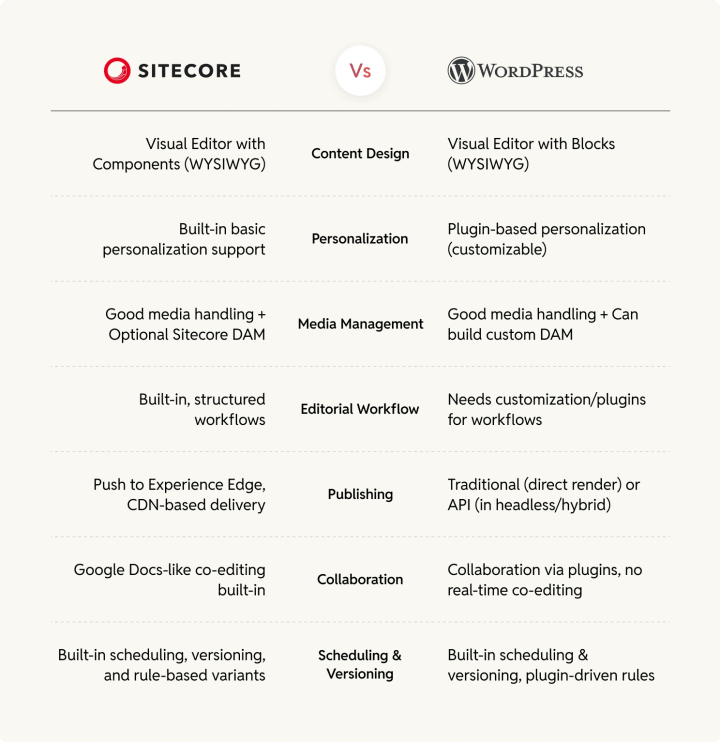
Here’s what it takes to go from ideation to production on Sitecore Cloud XM and WordPress.
- “Designing” your content: Both the platforms come with visual editors that support inline editing. So you can choose from Components in Sitecore or Blocks in WordPress and design your content as you write it. The WYSIWYG editors with both hugely simplify content management.
- Implementing personalizations: If you want to personalize your content, you can do some basic stuff right out-of-the-box with Sitecore. This is possible through plugins on WordPress.
- Adding media: Both the CMSs offer good media management and you can easily upload your videos, images, and documents to your content assets. If you use Sitecore, you can even consider their DAM solution. Alternatively, with WordPress, you can pretty much build your own bespoke DAM solution on top of WordPress.
- Moving the content along the editorial process: Both the platforms let you enforce editorial processes like adding stages for editorial and peer reviews. With Sitecore, it’s more straightforward whereas it’s possible with WordPress through customizations/plugins.
Publishing the content: With Sitecore, once you push your content to Sitecore’s Edge layer, the front-end delivery is handled through Sitecore’s global content delivery network. WordPress offers similar flexibility depending on your setup: In a traditional stack (monolithic WordPress), content is rendered directly through WordPress. And in a headless or hybrid setup, content is delivered via APIs, similar to Sitecore’s decoupled approach.The frontend solutions take it over from here.
Other than these, both offer features like content scheduling, versioning, and collaboration
Both the CMSs offer content scheduling, so your content can go live when you want, ideal for timing content campaigns to marketing calendars.
Both the CMSs also support versioning and automatically save your latest versions. Also, because Sitecore comes with some lightweight in-built personalizations, you can create personalized versions of your page and use rules to deliver them to the intended audiences.
Also, while both the platforms support collaborating (built-in in Sitecore and through plugins in WordPress) on the editorial processes, only Sitecore allows for Google Docs-like collaboration on a content piece (co-editing, in other words).
The content team’s experience with the CMS (and why it matters)
If you’ve seen CMS migration case studies, you’ll know that a lot of times, businesses move to a new CMS because they see their content teams struggling with making the most of their existing CMSs. Often, this is due to bottlenecks in the publishing process, with content teams having to rely too heavily on the IT department for daily content ops like updates and publishing. The team at KFF experience this with their Sitecore CMS:
Publishing new content online? It was a broken workflow. “The [content] staff didn’t touch the CMS,” explains KFF Vice President David Rousseau. “They wrote things in Word, sent it to the production team, and they put it online.”
It’s important to note that such issues aren’t just about slowing the content pipeline, they can stifle creativity too. As KFF mentions in this case study, getting content creators to actually work inside the CMS helps them do more with content. “With WordPress, [our] workflow is changing dramatically,” says David. “We’ve trained many of our content creators in the CMS. And, the closer the content creators are to it, the more creatively they are able to think about it.”
WordPress is beyond doubt the world’s most loved content creation platform, celebrated for its user-friendliness.
Sitecore, too, does nicely here with its XM Cloud’s Pages editor. This new editor builds upon Sitecore’s earlier editors that weren’t so user-friendly.
Training
While Sitecore’s content production has a learning curve, WordPress is quite straightforward.
Training and getting your new hires up-to-speed with how Sitecore and any customizations you may have built on top of it, too, can add considerable overhead to your daily content operations.
With WordPress, on the other hand, you can safely say that anyone with even an hour’s worth of training can be ready to write their first post and submit it for approval!
Headless implementation
PREVIOUS
Credits

Disha Sharma
Author
Disha Sharma
Author
Disha Sharma is a Content Writer at rtCamp with over a decade of experience at the intersection of technology, digital marketing, and enterprise content strategy. Her WordPress roots run deep, her …

Good Work. Good People.
Industry partnerships


Compliance certifications


 United States India
© rtCamp Inc. since 2009. All rights reserved.
Terms of Service · Privacy Policy · Trust Center
Company
Solutions
Subscribe to our newsletter and get a few email updates every month.
United States India
© rtCamp Inc. since 2009. All rights reserved.
Terms of Service · Privacy Policy · Trust Center
Cookie Consent
We value your privacy
We use cookies to give you the best possible experience. By clicking “Accept,” you consent to our use of cookies to improve site functionality, analyze usage, and personalize content and communications. Your privacy matters to us, and we are committed to handling your data responsibly and transparently. Please check our Privacy Policy for more details.
Manage PreferencesDon’t AllowAllow All
Why do we use cookies?
×
By clicking "Accept" or "Decline All" at the bottom, you consent to the use of cookies and other tools as described in our Cookie Policy in accordance with your settings and accept our Terms of Service.
Toggle EssentialEssential
Essential cookies enable basic functions and are necessary for the proper function of the website.
Name
Description
Duration
Geolocation Config
This cookie is used to store the consent settings based on the visitor's location.
30 days
Cookie Preferences
This cookie is used to store the user's cookie consent preferences.
30 days
Toggle CloudFlareCloudFlare
CloudFlare provides web performance and security solutions, enhancing site speed and protecting against threats.
Service URL: developers.cloudflare.com (opens in a new window)
Name
Description
Duration
cf_clearance
Whether a CAPTCHA or Javascript challenge has been solved.
session
Toggle CommentsComments
These cookies are needed for adding comments on this website.
Name
Description
Duration
comment_author
Used to track the user across multiple sessions.
Session
comment_author_email
Used to track the user across multiple sessions.
Session
comment_author_url
Used to track the user across multiple sessions.
Session
Toggle GodamGodam
GoDAM" is primarily a specialized WordPress plugin and media management service designed to enhance video hosting, marketing, and asset management directly within the WordPress dashboard.
Service URL: godam.io (opens in a new window)
Name
Description
Duration
user_image
Temporarily stores the path to the user's avatar or profile picture for quick rendering in the website header.
session
user_id
Stores the numerical ID of the logged-in user to maintain session continuity and basic site operations.
session
full_name
Stores the logged-in user's display name to personalize the site interface without needing database queries.
session
system_user
First-party cookie used to store basic application state identifying the current system user role.
session
sid
A generic session ID cookie used to maintain user state and functionality as the visitor navigates through the site.
session
Toggle Google reCAPTCHAGoogle reCAPTCHA
Google reCAPTCHA helps protect websites from spam and abuse by verifying user interactions through challenges.
Name
Description
Duration
_GRECAPTCHA
Google reCAPTCHA sets a necessary cookie (_GRECAPTCHA) when executed for the purpose of providing its risk analysis.
179 days
Toggle Google Tag ManagerGoogle Tag Manager
Google Tag Manager simplifies the management of marketing tags on your website without code changes.
Name
Description
Duration
cookiePreferences
Registers cookie preferences of a user
2 years
td
Registers statistical data on users' behaviour on the website. Used for internal analytics by the website operator.
session
Toggle StatisticsStatistics
Statistics cookies collect information anonymously. This information helps us understand how visitors use our website.
Toggle Factors AIFactors AI
Factors.ai is a B2B account intelligence and marketing analytics platform that helps Go-To-Market (GTM) teams identify anonymous website visitors, track buyer journeys, and measure the ROI of marketing campaigns.
Service URL: www.factors.ai (opens in a new window)
Name
Description
Duration
_fuid
It is sent to capture session details and track user behavior across your website to provide behavioral data and intent signals.
1 Year
Toggle Google AnalyticsGoogle Analytics
Google Analytics is a powerful tool that tracks and analyzes website traffic for informed marketing decisions.
Service URL: policies.google.com (opens in a new window)
Name
Description
Duration
FPGSID
Stores a session or user identifier to track how visitors interact with a website. This helps Google Analytics measure website performance, user engagement, and usage patterns.
Session
FPLC
Used by Google Analytics to link visitor interactions and sessions across multiple related domains.
20 hours
FPID
A server-side Google Analytics cookie used as an alternative user identifier when third-party cookies are restricted.
2 years
_ga
ID used to identify users
2 years
_ga_
ID used to identify users
2 years
Toggle Jetpack StatsJetpack Stats
Jetpack's built-in visitor analytics. It records page views, referring sites, search terms, and outbound link clicks, and also carries the shared visitor-tracking library used by Jetpack Instant Search and WooCommerce Analytics.
Service URL: automattic.com (opens in a new window)
Name
Description
Duration
tk_aip
Stores a list of anonymous visitor IDs so they can be merged into one identity once a visitor is recognized.
Up to 5 years
tk_tc
Used once per page load to work out which cookie domain the Tracks library should use, then removed as soon as it's read back.
Session (deleted immediately after use)
tk_qs
Queues analytics events for Jetpack's Tracks library so none are lost if the page closes before they can be sent.
30 minutes
tk_ai
Stores a randomly-generated anonymous visitor ID so Jetpack's Tracks analytics library can link tracking events to the same visitor.
Session in wp-admin; up to 5 years on the frontend
Toggle Microsoft ClarityMicrosoft Clarity
Clarity is a web analytics service that tracks and reports website traffic.
Service URL: clarity.microsoft.com (opens in a new window)
Name
Description
Duration
CLID
Identifies the first-time Clarity saw this user on any site using Clarity.
12 months
ANONCHK
Indicates whether MUID is transferred to ANID, a cookie used for advertising. Clarity doesn't use ANID and so this is always set to 0.
Session
_clck
Persists the Clarity User ID and preferences, unique to that site is attributed to the same user ID.
12 months
_clsk
Connects multiple page views by a user into a single Clarity session recording.
12 months
Toggle Parse.lyParse.ly
Parse.ly is a content analytics platform that helps publishers optimize audience engagement and content performance.
Name
Description
Duration
cookies.js_dtest
This cookie determines whether the browser accepts cookies.
session
_parsely_session
JSON document storing information identifying a browsing session according to Parsely’s proprietary definition
30 minutes
_parsely_visitor
JSON document uniquely identifying a browser and counting its sessions
13 months
Toggle SalespanelSalespanel
Salespanel is a B2B marketing and sales software that identifies, tracks, and qualifies website visitors and leads in real-time using first-party data. It helps businesses monitor customer journeys, score leads based on behavior, and syncs this data with CRMs (like Pipedrive or HubSpot) to improve conversion rates.
Service URL: salespanel.io (opens in a new window)
Name
Description
Duration
track_uid
Identify and tracking a lead
12 moths
Toggle MarketingMarketing
Marketing cookies are used to follow visitors to websites. The intention is to show ads that are relevant and engaging to the individual user.
Toggle Bing / MicrosoftBing / Microsoft
Bing, powered by Microsoft, is a search engine providing web, image, video, and map search capabilities.
Name
Description
Duration
MR
Used to collect information for analytics purposes.
6 months
ANONCHK
Used to store session ID for a users session to ensure that clicks from adverts on the Bing search engine are verified for reporting purposes and for personalisation
10 minutes
SM
Used by Microsoft in synchronizing the MUID across multiple Microsoft domains to track users for advertising.
session
MUID
Identifies unique web browsers visiting Microsoft sites. These cookies are used for advertising, site analytics, and other operational purposes.
1 year
Toggle DoubleClick/Google MarketingDoubleClick/Google Marketing
A comprehensive digital advertising platform for managing campaigns, optimizing performance, and analyzing audience data.
Name
Description
Duration
IDE
This cookie is used for targeting, analyzing and optimisation of ad campaigns in DoubleClick/Google Marketing Suite
2 years
ar_debug
Store and track conversions
Persistent
Toggle LinkedInLinkedIn
LinkedIn is a professional networking platform for job seekers, employers, and industry connections.
Name
Description
Duration
bscookie
Used by LinkedIn to track the use of embedded services.
1 year
AnalyticsSyncHistory
Used to store information about the time a sync with the lms_analytics cookie took place for users in the Designated Countries
30 days
bcookie
Used by LinkedIn to track the use of embedded services.
1 year
li_sugr
Used to make a probabilistic match of a user's identity outside the Designated Countries
90 days
lidc
Used by the social networking service, LinkedIn, for tracking the use of embedded services.
1 day
UserMatchHistory
Used by LinkedIn Ads to synchronize and match user IDs across different ad networks and data providers.
30 days
Toggle LinkedIn InsightLinkedIn Insight
LinkedIn Insight is a web analytics service that tracks and reports website traffic.
Service URL: www.linkedin.com (opens in a new window)
Name
Description
Duration
li_sugr
Used to make a probabilistic match of a user's identity.
90 days
lidc
Used for routing and session management.
24 hours
Toggle LiveIntentLiveIntent
LiveIntent provides a platform for email advertising and identity-driven marketing solutions.
Name
Description
Duration
_lc2_fpi_js
Companion cookie to _lc2_fpi used by JavaScript to facilitate cross-domain ad tracking and user identification.
1 year
_lc2_fpi
First-party tracking cookie usually associated with LiveRamp to identify users across devices for targeted advertising.
1 Year
_li_ss
Sets a unique ID for the visitor, that allows third party advertisers to target the visitor with relevant advertisement. This pairing service is provided by third party advertisement hubs, which facilitates real-time bidding for advertisers.
1 month
lidid
Collects data on visitors' behaviour and interaction - This is used to make advertisement on the website more relevant. The cookie also allows the website to detect any referrals from other websites.
2 years
Toggle Cookie PolicyCookie Policy
You can find more information in our Privacy Policy.
Allow AllDecline All
Accept