/handbook/contentful-vs-wordpress/enterprise-security/
What We Do
Digital Platform MigrationsKey SolutionsManaged ServicesStaffing SolutionsIndustriesProducts


OnePress
Unify multiple brands on one governed WordPress platform.

Design & UI/UX
Gutenberg-native UX, UI, and design systems for visitors and editors.

WordPress Modernization
Modernize WordPress for better performance, architecture, and AI readiness.

WordPress as a DXP
WordPress as a composable DXP when monolithic systems no longer cut it.

Headless WordPress
Omnichannel content delivery without sacrificing marketing autonomy.

Frappe/ERPNext
Build scalable ERP and custom applications, from implementation to ongoing support.

Discovery
Strategic consultancy & project roadmap

Growth Services
On demand development & consultation

Site Maintenance
Annual maintenance. Done for you

QE Services
Testing across SDLC for assured quality

Hosting Migration
Move to a performant hosting with zero downtime

WooCommerce
Enterprise commerce delivered without lock-in

AI
Unlock real use cases and integrations

All Services
A suite of services for any need
Technology STACK


eCommerce
Scale your e-commerce with WooCommerce, integrations, and custom extensions for growth.


EasyEngine
Server management tool that makes using WordPress on Nginx easy.

Web Auditor
Performance Audit & Insights for your Website.

rtMedia
A complete media management plugin for WordPress.
Resources


About Us


CLEAR
 Resources Contentful vs WordPress: A detailed comparison Security & compliance
Topics
On this page
- Contentful vs WordPress: A detailed comparison
- What is Contentful?
- What is WordPress?
- Frontend comparison
- Content workflow comparison
- Headless CMS configurations
- Security & compliance
- Multisite functionality
- Upgrades & support
- End-user experience comparison
- TCO & ROI comparison
- Verdict: The better CMS
Closed source vs open source security models
Community-driven security updates
Community-driven support insights
Customizing your security stack
Third-party integrations and transparency
Compliance and control
So, who does security better?
Last updated on Apr 1, 2026
Contentful vs WordPress Security for enterprises
When enterprises evaluate CMS platforms, security isn’t just a checklist item, it’s a dealbreaker. The risk exposure of a content platform that powers your website, customer portals, and apps can have brand, legal, and financial implications.
And yet, not all CMS platforms approach security the same way.
The difference between Contentful and WordPress starts at the root: one is a closed-source SaaS platform, and the other is an open-source ecosystem. That design choice influences everything, from how fast vulnerabilities are patched, to how much control your security team has.
Let’s break this down the way we often do with enterprise teams we work with starting with the architectural philosophy.
Closed source vs open source security models
Contentful’s closed-source nature means that the platform’s codebase is not available publicly. Using Contentful means relying on the vendor for updates, patches, and feature changes. While Contentful’s security processes are handled by a dedicated in-house team, this centralized approach limits flexibility for enterprises that may need tailored security measures or have specific compliance requirements. The responsibility for keeping the platform secure rests entirely on the vendor, and you have to trust Contentful’s security team to handle issues swiftly and correctly. While a good vendor takes care of these, delays may be possible in shipping security updates. Also, generally, enterprises will have less control over their security configurations.
WordPress, on the other hand, is fully open-source. You see everything. And more importantly, so does a global network of developers, security researchers, and plugin authors – who audit, patch, and iterate in near real-time. Vulnerabilities are often fixed faster than the vendor SLA cycles most proprietary platforms offer.
You don’t just get transparency, you get agency.
Community-driven security updates
Because Contentful is a proprietary platform, the responsibility for issuing security patches lies with the vendor. While this can create an assurance that a central team is managing the security of the platform, it means enterprises are left waiting for official updates. The potential risk here is that when vulnerabilities are discovered, there may be delays in patching them, leaving enterprises exposed.
WordPress’s open-source model, in contrast, thrives on community-driven updates. Security vulnerabilities are quickly identified by the community and often fixed rapidly. The WordPress community regularly reviews and updates security practices, and as a result, the platform has earned a reputation for being highly responsive to threats.
Community-driven support insights
A quick search on Stack Overflow reveals over 192,000 threads for WordPress-related queries, compared to around 874 for Contentful.
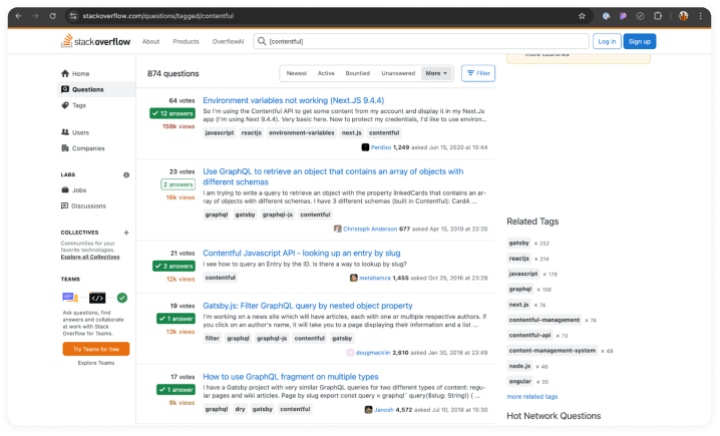
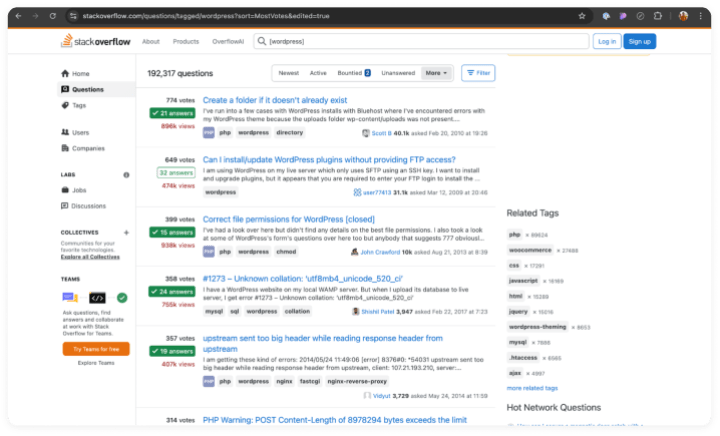
This stark difference highlights the breadth of community-driven knowledge and support available for WordPress users, making it easier to troubleshoot and innovate.
In addition, WordPress’s extensive ecosystem of plugins and themes is also monitored for vulnerabilities. Security experts and plugin developers constantly update and audit code to prevent malicious activity. This decentralized, community-driven approach means that even if vulnerabilities arise, there is a massive network of people working to fix them promptly.
Customizing your security stack
Contentful’s closed-source nature limits how enterprises can customize security protocols. Enterprises can leverage Contentful’s native security features, but they are constrained by the platform’s pre-built architecture. For example, integrating advanced security tools or configurations tailored to specific business requirements may require working closely with Contentful’s development team, which could result in delays or additional costs.
WordPress excels in customization, allowing enterprises to adjust and implement their own security protocols with ease. The open-source community frequently develops a wide range of security plugins and tools designed to address specific needs, whether it’s two-factor authentication, firewall protection, automated backups, or malware scanners.
Enterprises can choose from a vast selection of trusted tools or build their customized security systems. This flexibility ensures that WordPress can be adapted to meet the most stringent security and compliance standards, especially for enterprises that require tailored security features to align with their business processes.
Third-party integrations and transparency
With Contentful, third-party integrations and security plugins are limited, as the platform tightly controls the ecosystem. Enterprises must rely on the features Contentful offers or wait for the company to release new integrations or updates. While this controlled environment may reduce the likelihood of integration-related vulnerabilities, it also stifles the potential for custom security solutions that many enterprises need.
WordPress thrives on its ability to integrate with a wide variety of third-party security tools, offering a broad range of customizable solutions for enterprises. This flexibility allows enterprises to leverage best-in-class security products and services from external providers, ensuring that they can build a multi-layered security approach that addresses a wide range of potential threats.
The open-source ecosystem also ensures transparency in how these third-party tools are developed and maintained, offering enterprises greater visibility into their security measures.
Compliance and control
Contentful offers enterprise-grade security but relies on its centralized model to ensure compliance with various regulations (such as GDPR, SOC 2, etc.). While this may be sufficient for many enterprises, it doesn’t offer the same level of control over compliance configurations as WordPress.
When it comes to compliance and data security, WordPress offers much more flexibility. Enterprises can control data storage, encryption, and access policies directly within their WordPress environment, ensuring full compliance with local and international regulations. With the right plugins and configurations, WordPress can be tailored to meet highly specific compliance standards, providing more control to enterprise users than closed-source alternatives like Contentful.
So, who does security better?
It depends on what kind of enterprise you are.
If you want a secure platform managed entirely by the vendor, and you’re okay with limited visibility or customization, Contentful offers a strong foundation.
But if you need a CMS that gives you:
- Transparency
- Rapid patch cycles
- Customizable control layers
- Integration freedom
- Community-powered resilience
…then WordPress has the edge. And when paired with hardened infrastructure (like WordPress VIP, SnapWP, or your hardened environment), it’s not just secure, it’s battle-tested at scale.
Headless CMS configurations
PREVIOUS
Credits

Utsav Patel
Author
Utsav Patel
Author

Disha Sharma
Author
Disha Sharma
Author
Disha Sharma is a Content Writer at rtCamp with over a decade of experience at the intersection of technology, digital marketing, and enterprise content strategy. Her WordPress roots run deep, her …

Shreya Agarwal
Editor
Shreya Agarwal
Editor
Shreya Agarwal is a Growth Engineer at rtCamp, she brings active, hands-on WordPress development credentials to everything she writes and reviews. A WordPress Core Contributor with merged pull requ…

Good Work. Good People.
Industry partnerships


Compliance certifications


 United States India
© rtCamp Inc. since 2009. All rights reserved.
Terms of Service · Privacy Policy · Trust Center
Company
Solutions
Subscribe to our newsletter and get a few email updates every month.
United States India
© rtCamp Inc. since 2009. All rights reserved.
Terms of Service · Privacy Policy · Trust Center
Cookie Consent
We value your privacy
We use cookies to give you the best possible experience. By clicking “Accept,” you consent to our use of cookies to improve site functionality, analyze usage, and personalize content and communications. Your privacy matters to us, and we are committed to handling your data responsibly and transparently. Please check our Privacy Policy for more details.
Manage PreferencesDon’t AllowAllow All
Why do we use cookies?
×
By clicking "Accept" or "Decline All" at the bottom, you consent to the use of cookies and other tools as described in our Cookie Policy in accordance with your settings and accept our Terms of Service.
Toggle EssentialEssential
Essential cookies enable basic functions and are necessary for the proper function of the website.
Name
Description
Duration
Geolocation Config
This cookie is used to store the consent settings based on the visitor's location.
30 days
Cookie Preferences
This cookie is used to store the user's cookie consent preferences.
30 days
Toggle CloudFlareCloudFlare
CloudFlare provides web performance and security solutions, enhancing site speed and protecting against threats.
Service URL: developers.cloudflare.com (opens in a new window)
Name
Description
Duration
cf_clearance
Whether a CAPTCHA or Javascript challenge has been solved.
session
Toggle CommentsComments
These cookies are needed for adding comments on this website.
Name
Description
Duration
comment_author
Used to track the user across multiple sessions.
Session
comment_author_email
Used to track the user across multiple sessions.
Session
comment_author_url
Used to track the user across multiple sessions.
Session
Toggle GodamGodam
GoDAM" is primarily a specialized WordPress plugin and media management service designed to enhance video hosting, marketing, and asset management directly within the WordPress dashboard.
Service URL: godam.io (opens in a new window)
Name
Description
Duration
user_image
Temporarily stores the path to the user's avatar or profile picture for quick rendering in the website header.
session
user_id
Stores the numerical ID of the logged-in user to maintain session continuity and basic site operations.
session
full_name
Stores the logged-in user's display name to personalize the site interface without needing database queries.
session
system_user
First-party cookie used to store basic application state identifying the current system user role.
session
sid
A generic session ID cookie used to maintain user state and functionality as the visitor navigates through the site.
session
Toggle Google reCAPTCHAGoogle reCAPTCHA
Google reCAPTCHA helps protect websites from spam and abuse by verifying user interactions through challenges.
Name
Description
Duration
_GRECAPTCHA
Google reCAPTCHA sets a necessary cookie (_GRECAPTCHA) when executed for the purpose of providing its risk analysis.
179 days
Toggle Google Tag ManagerGoogle Tag Manager
Google Tag Manager simplifies the management of marketing tags on your website without code changes.
Name
Description
Duration
cookiePreferences
Registers cookie preferences of a user
2 years
td
Registers statistical data on users' behaviour on the website. Used for internal analytics by the website operator.
session
Toggle StatisticsStatistics
Statistics cookies collect information anonymously. This information helps us understand how visitors use our website.
Toggle Factors AIFactors AI
Factors.ai is a B2B account intelligence and marketing analytics platform that helps Go-To-Market (GTM) teams identify anonymous website visitors, track buyer journeys, and measure the ROI of marketing campaigns.
Service URL: www.factors.ai (opens in a new window)
Name
Description
Duration
_fuid
It is sent to capture session details and track user behavior across your website to provide behavioral data and intent signals.
1 Year
Toggle Google AnalyticsGoogle Analytics
Google Analytics is a powerful tool that tracks and analyzes website traffic for informed marketing decisions.
Service URL: policies.google.com (opens in a new window)
Name
Description
Duration
FPGSID
Stores a session or user identifier to track how visitors interact with a website. This helps Google Analytics measure website performance, user engagement, and usage patterns.
Session
FPLC
Used by Google Analytics to link visitor interactions and sessions across multiple related domains.
20 hours
FPID
A server-side Google Analytics cookie used as an alternative user identifier when third-party cookies are restricted.
2 years
_ga
ID used to identify users
2 years
_ga_
ID used to identify users
2 years
Toggle Jetpack StatsJetpack Stats
Jetpack's built-in visitor analytics. It records page views, referring sites, search terms, and outbound link clicks, and also carries the shared visitor-tracking library used by Jetpack Instant Search and WooCommerce Analytics.
Service URL: automattic.com (opens in a new window)
Name
Description
Duration
tk_aip
Stores a list of anonymous visitor IDs so they can be merged into one identity once a visitor is recognized.
Up to 5 years
tk_tc
Used once per page load to work out which cookie domain the Tracks library should use, then removed as soon as it's read back.
Session (deleted immediately after use)
tk_qs
Queues analytics events for Jetpack's Tracks library so none are lost if the page closes before they can be sent.
30 minutes
tk_ai
Stores a randomly-generated anonymous visitor ID so Jetpack's Tracks analytics library can link tracking events to the same visitor.
Session in wp-admin; up to 5 years on the frontend
Toggle Microsoft ClarityMicrosoft Clarity
Clarity is a web analytics service that tracks and reports website traffic.
Service URL: clarity.microsoft.com (opens in a new window)
Name
Description
Duration
CLID
Identifies the first-time Clarity saw this user on any site using Clarity.
12 months
ANONCHK
Indicates whether MUID is transferred to ANID, a cookie used for advertising. Clarity doesn't use ANID and so this is always set to 0.
Session
_clck
Persists the Clarity User ID and preferences, unique to that site is attributed to the same user ID.
12 months
_clsk
Connects multiple page views by a user into a single Clarity session recording.
12 months
Toggle Parse.lyParse.ly
Parse.ly is a content analytics platform that helps publishers optimize audience engagement and content performance.
Name
Description
Duration
_parsely_session
JSON document storing information identifying a browsing session according to Parsely’s proprietary definition
30 minutes
_parsely_visitor
JSON document uniquely identifying a browser and counting its sessions
13 months
cookies.js_dtest
This cookie determines whether the browser accepts cookies.
session
Toggle MarketingMarketing
Marketing cookies are used to follow visitors to websites. The intention is to show ads that are relevant and engaging to the individual user.
Toggle Bing / MicrosoftBing / Microsoft
Bing, powered by Microsoft, is a search engine providing web, image, video, and map search capabilities.
Name
Description
Duration
MR
Used to collect information for analytics purposes.
6 months
ANONCHK
Used to store session ID for a users session to ensure that clicks from adverts on the Bing search engine are verified for reporting purposes and for personalisation
10 minutes
SM
Used by Microsoft in synchronizing the MUID across multiple Microsoft domains to track users for advertising.
session
MUID
Identifies unique web browsers visiting Microsoft sites. These cookies are used for advertising, site analytics, and other operational purposes.
1 year
Toggle DoubleClick/Google MarketingDoubleClick/Google Marketing
A comprehensive digital advertising platform for managing campaigns, optimizing performance, and analyzing audience data.
Name
Description
Duration
IDE
This cookie is used for targeting, analyzing and optimisation of ad campaigns in DoubleClick/Google Marketing Suite
2 years
ar_debug
Store and track conversions
Persistent
Toggle LinkedInLinkedIn
LinkedIn is a professional networking platform for job seekers, employers, and industry connections.
Name
Description
Duration
bscookie
Used by LinkedIn to track the use of embedded services.
1 year
AnalyticsSyncHistory
Used to store information about the time a sync with the lms_analytics cookie took place for users in the Designated Countries
30 days
bcookie
Used by LinkedIn to track the use of embedded services.
1 year
li_sugr
Used to make a probabilistic match of a user's identity outside the Designated Countries
90 days
lidc
Used by the social networking service, LinkedIn, for tracking the use of embedded services.
1 day
UserMatchHistory
Used by LinkedIn Ads to synchronize and match user IDs across different ad networks and data providers.
30 days
Toggle LinkedIn InsightLinkedIn Insight
LinkedIn Insight is a web analytics service that tracks and reports website traffic.
Service URL: www.linkedin.com (opens in a new window)
Name
Description
Duration
li_sugr
Used to make a probabilistic match of a user's identity.
90 days
lidc
Used for routing and session management.
24 hours
Toggle LiveIntentLiveIntent
LiveIntent provides a platform for email advertising and identity-driven marketing solutions.
Name
Description
Duration
_lc2_fpi_js
Companion cookie to _lc2_fpi used by JavaScript to facilitate cross-domain ad tracking and user identification.
1 year
_lc2_fpi
First-party tracking cookie usually associated with LiveRamp to identify users across devices for targeted advertising.
1 Year
_li_ss
Sets a unique ID for the visitor, that allows third party advertisers to target the visitor with relevant advertisement. This pairing service is provided by third party advertisement hubs, which facilitates real-time bidding for advertisers.
1 month
lidid
Collects data on visitors' behaviour and interaction - This is used to make advertisement on the website more relevant. The cookie also allows the website to detect any referrals from other websites.
2 years
Toggle Cookie PolicyCookie Policy
You can find more information in our Privacy Policy.
Allow AllDecline All
Accept