/handbook/umbraco-vs-wordpress/content-creation/
What We Do
Digital Platform MigrationsKey SolutionsManaged ServicesStaffing SolutionsIndustriesProducts


OnePress
Unify multiple brands on one governed WordPress platform.

Design & UI/UX
Gutenberg-native UX, UI, and design systems for visitors and editors.

WordPress Modernization
Modernize WordPress for better performance, architecture, and AI readiness.

WordPress as a DXP
WordPress as a composable DXP when monolithic systems no longer cut it.

Headless WordPress
Omnichannel content delivery without sacrificing marketing autonomy.

Frappe/ERPNext
Build scalable ERP and custom applications, from implementation to ongoing support.

Discovery
Strategic consultancy & project roadmap

Growth Services
On demand development & consultation

Site Maintenance
Annual maintenance. Done for you

QE Services
Testing across SDLC for assured quality

Hosting Migration
Move to a performant hosting with zero downtime

WooCommerce
Enterprise commerce delivered without lock-in

AI
Unlock real use cases and integrations

All Services
A suite of services for any need
Technology STACK


eCommerce
Scale your e-commerce with WooCommerce, integrations, and custom extensions for growth.


EasyEngine
Server management tool that makes using WordPress on Nginx easy.

Web Auditor
Performance Audit & Insights for your Website.

rtMedia
A complete media management plugin for WordPress.
Resources


About Us



CLEAR
 Resources Ubraco vs WordPress: A detailed comparison Content workflow comparison
Topics
On this page
- Ubraco vs WordPress: A detailed comparison
- What is Umbraco?
- What is WordPress?
- TCO & ROI comparison
- CMS architecture comparison
- Content workflow comparison
- User management comparison
- Scalability, extensibility & customizations
- Personalization at scale
- Security & compliance
- Upgrades & support
- Verdict: The better CMS
Content creation in Umbraco
Tree-based hierarchy for content nodes
Angular-based block editor
Reusable and nested content blocks
Structured media library
Publishing tools
Localization with multilingual capabilities
Content modeling
Content creation in WordPress
Flat structure with predefined post types
React-based Block Editor (Gutenberg)
Media uploader and editor
Localization with multilingual capabilities
Publishing tools
Content modeling
SEO in Umbraco vs WordPress: An enterprise perspective
WordPress: End-to-end SEO readiness through mature plugin ecosystems
Umbraco: Developer-centric flexibility, but SEO needs to be assembled
The bottom line
Taxonomy in Umbraco vs WordPress: Structuring content for scale
WordPress: Mature, UI-first taxonomy system
Umbraco: Structured content through composition, but no native taxonomy layer
The bottom line
Why WordPress delivers more for modern content teams
Last updated on Apr 15, 2026
Umbraco vs WordPress: Scalable Content Creation for Enterprises
If you think about it, content creation is where digital strategy turns into day-to-day execution. In evaluating Umbraco vs WordPress, the decision comes down to how each platform supports your teams’ ability to move fast, maintain consistency, and scale content operations.
While both platforms enable rich publishing experiences, they’re optimized for different organizational models.
Umbraco tends to be more developer-led, offering granular control through custom coding. WordPress, on the other hand, is content-led, simple enough for marketers to run with, yet powerful enough for developers to customize, extend, and scale. It strikes just the right balance between ease of use and enterprise-grade content capabilities. Let’s zoom in on content creation in Umbraco first.
Content creation in Umbraco
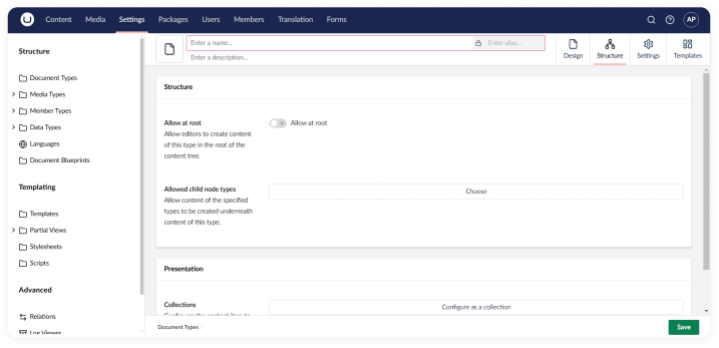
The Umbraco Backoffice interface serves as the primary workspace for content creators, marketers, and developers. This is where all content is created, reviewed, and managed.

Tree-based hierarchy for content nodes
Umbraco employs a tree-based hierarchy to organize content, making it useful to organize the site architecture.
- Content nodes represent individual pages, sections, or data points.
- The hierarchy allows easy navigation, with parent-child relationships for structured organization.
- Editors can visualize the entire website layout and drill down into specific nodes for edits.
Angular-based block editor
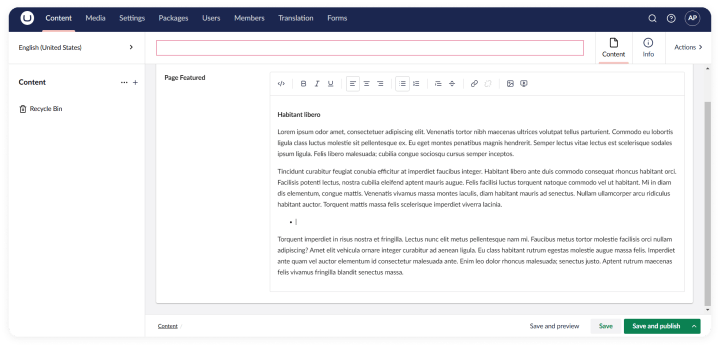
Umbraco’s block editor, built on Angular, provides a modular approach to content creation.
- Blocks represent reusable content components like text sections, images, and calls to action.
- It supports nested blocks, enabling creators to build complex layouts from simple, reusable pieces.
- The editor is tailored for developers to define functionality while empowering content creators to work within those boundaries.
Reusable and nested content blocks
Umbraco excels in creating reusable and nested content blocks, saving time and maintaining consistency.
- Reusable blocks like banners, testimonials, or promotional sections can be applied across pages.
- Nested blocks allow you to compose complex layouts, such as a page with a hero section containing multiple images, text areas, and CTAs.
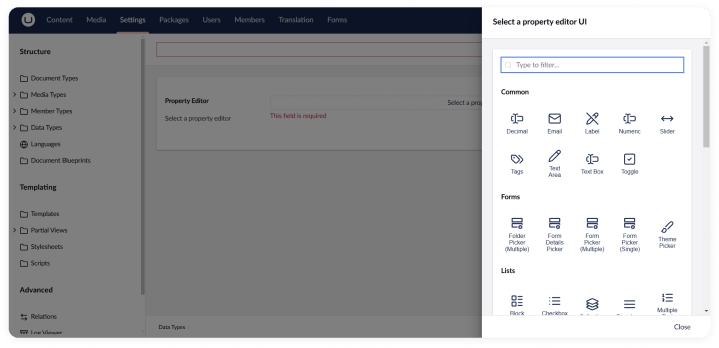
Structured media library
Umbraco’s media library offers features for managing and organizing assets:
- Assets like images, PDFs, and videos are categorized and tagged for easy retrieval.
- Media files can be linked to content nodes directly, ensuring consistent usage across the site.
- Structured metadata ensures content can be personalized or filtered dynamically.
Publishing tools
Umbraco offers granular publishing controls:
- Draft mode: Save content in draft without exposing it to live environments.
- Scheduled publishing: Automatically publish content at a predetermined time.
- Content previews: Enables you to see how your content will appear on different devices.
- Versioning: Tracks changes to content for easy rollback or review.
- Approval workflows: Define custom approval processes to ensure quality.
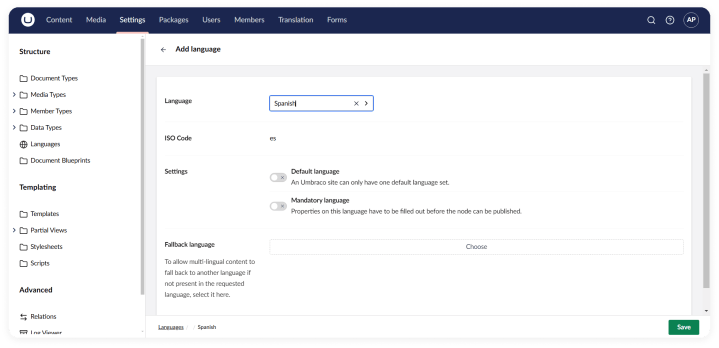
Localization with multilingual capabilities
Umbraco supports localization out of the box, enabling editors to create region-specific or language-specific versions of content.
Content modeling
Umbraco is built for structured content from the ground up. Using Document Types, Data Types, and Compositions, developers can model content schemas with precision, enforcing field types, validation, and relationships.
This approach gives teams control over structure and governance, especially useful in multi-language, multi-site, or headless scenarios.
However, Umbraco’s modeling is entirely developer-driven. Editors cannot create or modify content types themselves, and the content tree structure can become rigid or overly nested without careful planning. There’s also no visual content model builder in the UI, everything is configured in the back office or code.
Let’s now look at WordPress’s content creation experience.
Content creation in WordPress
The WordPress dashboard is widely recognized for its simplicity and ease of use, especially for non-technical users. Additionally, the Site Editor empowers you to customize the entire website, providing a more integrated way to build your WordPress instance.

Flat structure with predefined post types
WordPress uses a flat structure with predefined post types, such as:
- Posts (dynamic content like blogs).
- Pages (static content like About or Contact).
- Custom Post Types (e.g., products or portfolios) extend this flexibility.
Categories and tags allow logical organization, though lacking a visual hierarchy.
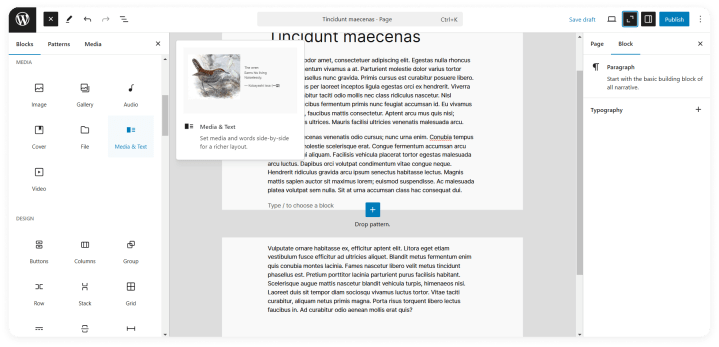
React-based Block Editor (Gutenberg)
The WordPress Block Editor, built on React, delivers an intuitive, WYSIWYG editing experience:
- Drag-and-drop blocks for text, images, videos, galleries, and reusable components.
- Inline previews show content as it will appear on the live site.
Media uploader and editor
WordPress’s media uploader allows quick asset uploads and offers basic editing tools:
- Crop, resize, or rotate images within the CMS.
- Plugins can extend functionality for optimization or advanced editing.

Localization with multilingual capabilities
Localization requires plugins like WPML or Polylang for multilingual content and configured with multisite setup.

Publishing tools
WordPress includes standard publishing tools:
- Save drafts or schedule posts for specific times.
- Basic roles and permissions like Author, Editor, and Administrator manage access.
- Plugins like PublishPress enhance workflow approvals and collaboration.
Content modeling
WordPress wasn’t originally designed for structured content, but it has evolved. With Custom Post Types, Custom Fields, and Custom Taxonomies, you can model a wide range of content types. The experience is significantly enhanced through plugins like Advanced Custom Fields (ACF) or Pods, which allow for visual modeling, reusable field groups, conditional logic, and more.
Unlike Umbraco, non-technical teams can often configure or extend models with the right UI tools, reducing developer bottlenecks.
However, consistency and governance across large deployments require planning and adherence to conventions, WordPress’s flexibility can become a liability if poorly managed.
SEO in Umbraco vs WordPress: An enterprise perspective
When evaluating Umbraco and WordPress for SEO at an enterprise level, it’s important to move past tactical tweaks and think strategically about organic visibility, content operations, and long-term search performance across large, often multilingual or multisite ecosystems.
WordPress: End-to-end SEO readiness through mature plugin ecosystems
WordPress is widely recognized for offering near-complete end-to-end SEO solutions through plugins such as Yoast SEO, All in One SEO, and Rank Math. These tools don’t just handle basic metadata; they integrate with schema.org, XML sitemaps, robots.txt, Open Graph, and even AI-assisted content optimization. For enterprises managing hundreds or thousands of pages, this level of out-of-the-box SEO capability significantly reduces the need for custom development, while also aligning marketing and content teams with technical SEO requirements, within the CMS UI itself.
This also means marketers, editors, and SEO specialists can collaborate in real-time, run SEO audits, define redirects, monitor readability, and even localize metadata without relying on development teams. With Multisite and multilingual plugins, these capabilities scale cleanly across regions.
Umbraco: Developer-centric flexibility, but SEO needs to be assembled
As a developer-first .NET CMS, Umbraco expects SEO to be custom-implemented or composed via packages like SEO Toolkit or uMarketingSuite. These tools can provide advanced functionality but require deeper integration and ongoing maintenance.
This isn’t inherently a drawback as Umbraco’s architecture allows for extremely customized SEO setups which can be a fit for organizations with highly specific requirements and dedicated internal development teams. But it also means that enterprise SEO on Umbraco is not plug-and-play. Configuring proper metadata handling, sitemap generation, canonical logic, and multilingual SEO often requires developer hours, especially when optimizing for structured content or headless delivery scenarios.
The bottom line
For enterprises prioritizing search visibility at scale, WordPress offers a significantly faster and more collaborative SEO operational model. Its ecosystem supports both technical SEO depth and editorial autonomy, reducing overhead while keeping search optimization tightly integrated into content lifecycles.
Umbraco, on the other hand, is better suited to organizations that have the resources and intention to build SEO capabilities from the ground up, possibly in alignment with complex internal systems or custom frontends.
Taxonomy in Umbraco vs WordPress: Structuring content for scale
Taxonomy isn’t just a matter of categories and tags, it’s foundational to information architecture, content governance, and discoverability across large, often multilingual, multisite digital ecosystems. How a CMS handles taxonomy directly impacts everything from SEO to personalization and internal search performance.
WordPress: Mature, UI-first taxonomy system
WordPress offers a well-defined, native taxonomy model that supports two built-in types: categories (hierarchical) and tags (non-hierarchical)—along with the ability to register custom taxonomies via code or plugins like Advanced Custom Fields (ACF) or Custom Post Type UI. These taxonomies can be tightly integrated with any custom post type and are fully exposed in the WordPress REST API, enabling seamless headless or decoupled implementations.
From a governance perspective, WordPress’s taxonomy tools are accessible from the admin UI, allowing content teams to manage, group, and tag content without needing developer support. This ease-of-use scales well in multisite setups or when managing large knowledge bases, editorial content libraries, or product catalogs.
Taxonomies in WordPress are also tightly integrated with URL routing, filters, and archive templates, which helps maintain semantic site structures and support SEO-friendly navigation without custom routing logic.
Umbraco: Structured content through composition, but no native taxonomy layer
Umbraco does not have a native taxonomy framework like WordPress. Instead, taxonomy must be modeled manually using content types, document types, or data types (such as dropdown lists), often structured via compositions. This gives developers high flexibility but comes at the cost of editorial efficiency and scalability. Taxonomy management in Umbraco is typically developer-driven.
Since this model is developer-driven, it allows enterprises to define exactly how content relationships work, but the absence of a standardized taxonomy layer means that implementing tag-based filtering, category archives, or content grouping logic needs custom development. There are packages (e.g., Umbraco Taxonomy Content Model or uSync) that help manage consistency, but taxonomy still tends to live more in code than in the UI.
In multilingual or multisite contexts, taxonomy governance in Umbraco can become even more complex unless strict content modeling standards are enforced, since there’s no global taxonomy system shared across sites or languages unless explicitly built.
The bottom line
Umbraco, while powerful in custom structuring, lacks a native taxonomy framework. This places more responsibility on development teams to implement and maintain content relationships in a scalable and editor-friendly way. It’s best suited for enterprises that require highly specific taxonomy models and have long-term development capacity to support them. A comparable setup in WordPress would be a lot easier and maintainable.
Why WordPress delivers more for modern content teams
In evaluating Umbraco vs WordPress for content creation, setting up your content infrastructure on Umbraco demands upfront technical investment and ongoing .NET expertise. WordPress, on the other hand, ships a lot either out of the box or through its mature ecosystem—often with end-to-end solutions for content modeling, taxonomy, SEO, and editorial workflows. For enterprises, the choice often comes down to whether you value bespoke architecture and developer control (Umbraco) or speed, flexibility, and a well-supported ecosystem that empowers content teams directly (WordPress).
CMS architecture comparison
PREVIOUS
User management comparison
NEXT
Credits

Abhijit Prabhudan
Author
Abhijit Prabhudan
Author
Works on content systems, publishing workflows, and knowledge management. Diverse experience spans editorial, marketing, ecommerce, and IT support. He operates across open source platforms, hand…

Disha Sharma
Author
Disha Sharma
Author
Disha Sharma is a Content Writer at rtCamp with over a decade of experience at the intersection of technology, digital marketing, and enterprise content strategy. Her WordPress roots run deep, her …

Shreya Agarwal
Editor
Shreya Agarwal
Editor
Shreya Agarwal is a Growth Engineer at rtCamp, she brings active, hands-on WordPress development credentials to everything she writes and reviews. A WordPress Core Contributor with merged pull requ…

Good Work. Good People.
Industry partnerships


Compliance certifications


 United States India
© rtCamp Inc. since 2009. All rights reserved.
Terms of Service · Privacy Policy · Trust Center
Company
Solutions
Subscribe to our newsletter and get a few email updates every month.
United States India
© rtCamp Inc. since 2009. All rights reserved.
Terms of Service · Privacy Policy · Trust Center
Cookie Consent
We value your privacy
We use cookies to give you the best possible experience. By clicking “Accept,” you consent to our use of cookies to improve site functionality, analyze usage, and personalize content and communications. Your privacy matters to us, and we are committed to handling your data responsibly and transparently. Please check our Privacy Policy for more details.
Manage PreferencesDon’t AllowAllow All
Why do we use cookies?
×
By clicking "Accept" or "Decline All" at the bottom, you consent to the use of cookies and other tools as described in our Cookie Policy in accordance with your settings and accept our Terms of Service.
Toggle EssentialEssential
Essential cookies enable basic functions and are necessary for the proper function of the website.
Name
Description
Duration
Geolocation Config
This cookie is used to store the consent settings based on the visitor's location.
30 days
Cookie Preferences
This cookie is used to store the user's cookie consent preferences.
30 days
Toggle CloudFlareCloudFlare
CloudFlare provides web performance and security solutions, enhancing site speed and protecting against threats.
Service URL: developers.cloudflare.com (opens in a new window)
Name
Description
Duration
cf_clearance
Whether a CAPTCHA or Javascript challenge has been solved.
session
Toggle CommentsComments
These cookies are needed for adding comments on this website.
Name
Description
Duration
comment_author
Used to track the user across multiple sessions.
Session
comment_author_email
Used to track the user across multiple sessions.
Session
comment_author_url
Used to track the user across multiple sessions.
Session
Toggle GodamGodam
GoDAM" is primarily a specialized WordPress plugin and media management service designed to enhance video hosting, marketing, and asset management directly within the WordPress dashboard.
Service URL: godam.io (opens in a new window)
Name
Description
Duration
user_image
Temporarily stores the path to the user's avatar or profile picture for quick rendering in the website header.
session
user_id
Stores the numerical ID of the logged-in user to maintain session continuity and basic site operations.
session
full_name
Stores the logged-in user's display name to personalize the site interface without needing database queries.
session
system_user
First-party cookie used to store basic application state identifying the current system user role.
session
sid
A generic session ID cookie used to maintain user state and functionality as the visitor navigates through the site.
session
Toggle Google reCAPTCHAGoogle reCAPTCHA
Google reCAPTCHA helps protect websites from spam and abuse by verifying user interactions through challenges.
Name
Description
Duration
_GRECAPTCHA
Google reCAPTCHA sets a necessary cookie (_GRECAPTCHA) when executed for the purpose of providing its risk analysis.
179 days
Toggle Google Tag ManagerGoogle Tag Manager
Google Tag Manager simplifies the management of marketing tags on your website without code changes.
Name
Description
Duration
cookiePreferences
Registers cookie preferences of a user
2 years
td
Registers statistical data on users' behaviour on the website. Used for internal analytics by the website operator.
session
Toggle StatisticsStatistics
Statistics cookies collect information anonymously. This information helps us understand how visitors use our website.
Toggle Factors AIFactors AI
Factors.ai is a B2B account intelligence and marketing analytics platform that helps Go-To-Market (GTM) teams identify anonymous website visitors, track buyer journeys, and measure the ROI of marketing campaigns.
Service URL: www.factors.ai (opens in a new window)
Name
Description
Duration
_fuid
It is sent to capture session details and track user behavior across your website to provide behavioral data and intent signals.
1 Year
Toggle Google AnalyticsGoogle Analytics
Google Analytics is a powerful tool that tracks and analyzes website traffic for informed marketing decisions.
Service URL: policies.google.com (opens in a new window)
Name
Description
Duration
FPGSID
Stores a session or user identifier to track how visitors interact with a website. This helps Google Analytics measure website performance, user engagement, and usage patterns.
Session
FPLC
Used by Google Analytics to link visitor interactions and sessions across multiple related domains.
20 hours
FPID
A server-side Google Analytics cookie used as an alternative user identifier when third-party cookies are restricted.
2 years
_ga
ID used to identify users
2 years
_ga_
ID used to identify users
2 years
Toggle Jetpack StatsJetpack Stats
Jetpack's built-in visitor analytics. It records page views, referring sites, search terms, and outbound link clicks, and also carries the shared visitor-tracking library used by Jetpack Instant Search and WooCommerce Analytics.
Service URL: automattic.com (opens in a new window)
Name
Description
Duration
tk_aip
Stores a list of anonymous visitor IDs so they can be merged into one identity once a visitor is recognized.
Up to 5 years
tk_tc
Used once per page load to work out which cookie domain the Tracks library should use, then removed as soon as it's read back.
Session (deleted immediately after use)
tk_qs
Queues analytics events for Jetpack's Tracks library so none are lost if the page closes before they can be sent.
30 minutes
tk_ai
Stores a randomly-generated anonymous visitor ID so Jetpack's Tracks analytics library can link tracking events to the same visitor.
Session in wp-admin; up to 5 years on the frontend
Toggle Microsoft ClarityMicrosoft Clarity
Clarity is a web analytics service that tracks and reports website traffic.
Service URL: clarity.microsoft.com (opens in a new window)
Name
Description
Duration
CLID
Identifies the first-time Clarity saw this user on any site using Clarity.
12 months
ANONCHK
Indicates whether MUID is transferred to ANID, a cookie used for advertising. Clarity doesn't use ANID and so this is always set to 0.
Session
_clck
Persists the Clarity User ID and preferences, unique to that site is attributed to the same user ID.
12 months
_clsk
Connects multiple page views by a user into a single Clarity session recording.
12 months
Toggle Parse.lyParse.ly
Parse.ly is a content analytics platform that helps publishers optimize audience engagement and content performance.
Name
Description
Duration
_parsely_session
JSON document storing information identifying a browsing session according to Parsely’s proprietary definition
30 minutes
_parsely_visitor
JSON document uniquely identifying a browser and counting its sessions
13 months
cookies.js_dtest
This cookie determines whether the browser accepts cookies.
session
Toggle MarketingMarketing
Marketing cookies are used to follow visitors to websites. The intention is to show ads that are relevant and engaging to the individual user.
Toggle Bing / MicrosoftBing / Microsoft
Bing, powered by Microsoft, is a search engine providing web, image, video, and map search capabilities.
Name
Description
Duration
MR
Used to collect information for analytics purposes.
6 months
ANONCHK
Used to store session ID for a users session to ensure that clicks from adverts on the Bing search engine are verified for reporting purposes and for personalisation
10 minutes
SM
Used by Microsoft in synchronizing the MUID across multiple Microsoft domains to track users for advertising.
session
MUID
Identifies unique web browsers visiting Microsoft sites. These cookies are used for advertising, site analytics, and other operational purposes.
1 year
Toggle DoubleClick/Google MarketingDoubleClick/Google Marketing
A comprehensive digital advertising platform for managing campaigns, optimizing performance, and analyzing audience data.
Name
Description
Duration
IDE
This cookie is used for targeting, analyzing and optimisation of ad campaigns in DoubleClick/Google Marketing Suite
2 years
ar_debug
Store and track conversions
Persistent
Toggle LinkedInLinkedIn
LinkedIn is a professional networking platform for job seekers, employers, and industry connections.
Name
Description
Duration
bscookie
Used by LinkedIn to track the use of embedded services.
1 year
AnalyticsSyncHistory
Used to store information about the time a sync with the lms_analytics cookie took place for users in the Designated Countries
30 days
bcookie
Used by LinkedIn to track the use of embedded services.
1 year
li_sugr
Used to make a probabilistic match of a user's identity outside the Designated Countries
90 days
lidc
Used by the social networking service, LinkedIn, for tracking the use of embedded services.
1 day
UserMatchHistory
Used by LinkedIn Ads to synchronize and match user IDs across different ad networks and data providers.
30 days
Toggle LinkedIn InsightLinkedIn Insight
LinkedIn Insight is a web analytics service that tracks and reports website traffic.
Service URL: www.linkedin.com (opens in a new window)
Name
Description
Duration
li_sugr
Used to make a probabilistic match of a user's identity.
90 days
lidc
Used for routing and session management.
24 hours
Toggle LiveIntentLiveIntent
LiveIntent provides a platform for email advertising and identity-driven marketing solutions.
Name
Description
Duration
_lc2_fpi_js
Companion cookie to _lc2_fpi used by JavaScript to facilitate cross-domain ad tracking and user identification.
1 year
_lc2_fpi
First-party tracking cookie usually associated with LiveRamp to identify users across devices for targeted advertising.
1 Year
_li_ss
Sets a unique ID for the visitor, that allows third party advertisers to target the visitor with relevant advertisement. This pairing service is provided by third party advertisement hubs, which facilitates real-time bidding for advertisers.
1 month
lidid
Collects data on visitors' behaviour and interaction - This is used to make advertisement on the website more relevant. The cookie also allows the website to detect any referrals from other websites.
2 years
Toggle Cookie PolicyCookie Policy
You can find more information in our Privacy Policy.
Allow AllDecline All
Accept